Skip to content
SentinelHSE
Fire extinguisher management

Every extinguisher, every month, with the tag to prove it.

The full register, QR tags on the cylinders, NFPA 10 inspections from a phone, and an overdue unit that raises its own work order.

An extinguisher fails once, and only when it matters.

A depressurised unit looks exactly like a working one from across the bay. So does one with a missing pin, a cracked hose, or a service tag that expired fourteen months ago. Nothing about a red cylinder on a bracket tells you it will work — which is why the inspection is monthly, and why the record is the point.

The paper tag on the neck has the opposite problem. It proves a signature, not a pressure reading. It does not survive the cylinder being repainted or swapped out. And it cannot tell you this morning which of your sixteen units are overdue — for that, somebody has to walk to all of them.

An extinguisher that fails on an incipient fire turns a wet floor into a total loss.
The check

Scan the tag. Ten checks. Done.

A round that ends with typing a clipboard into a spreadsheet is a round that gets skipped. The record is made at the bracket, by the person looking at the gauge.

One cylinder end to end — its record and tag, the ten checks that run against it, and what the record keeps afterwards. Every control on all three. Hover a card to light that control on the screen, or hover the screenshots themselves to magnify them and click to open one full size.
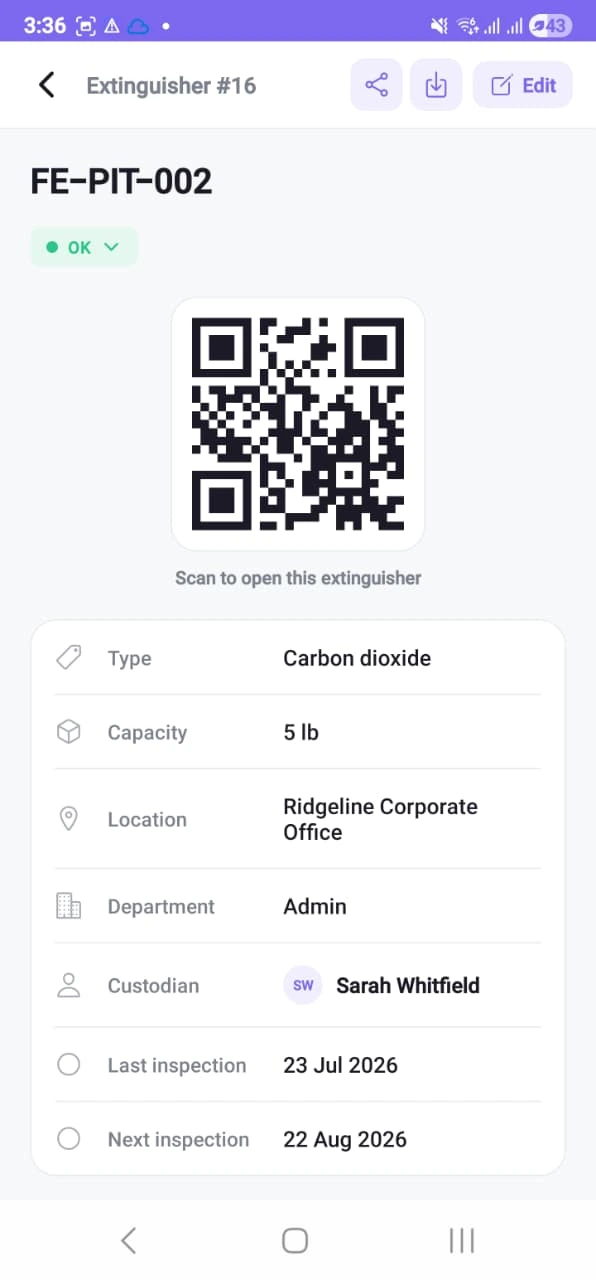
A fire extinguisher record on a phone: asset code FE-PIT-002, status OK, its QR label, and the type, capacity, location, department, custodian, last inspection and next inspection

The cylinder, on the phone

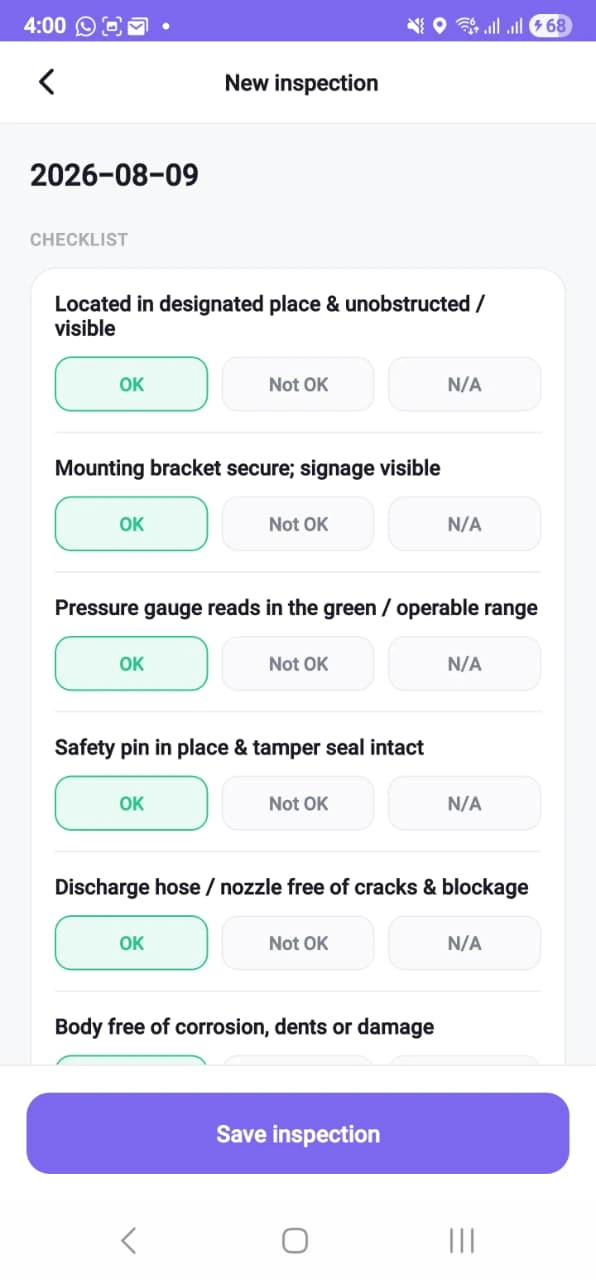
A new extinguisher inspection on a phone, dated 2026-08-09: checklist steps for location, mounting bracket, pressure gauge, safety pin, discharge hose and body condition, each offering OK, Not OK and N/A with OK pre-selected, above a save button

The check, at the bracket

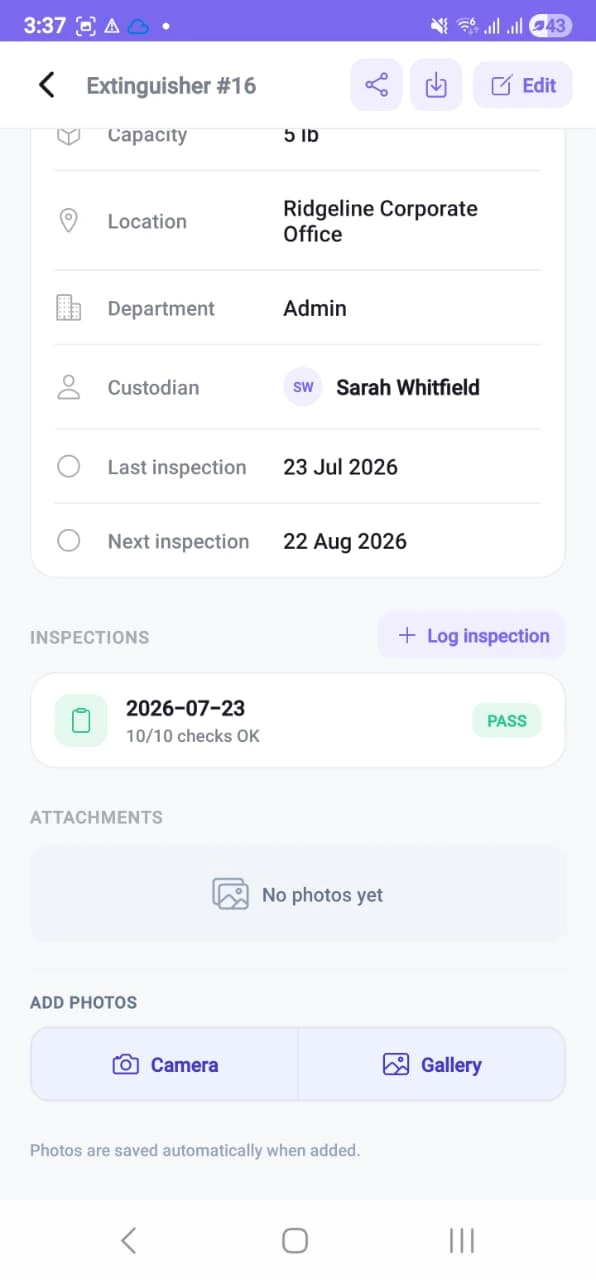
The same extinguisher record scrolled down: its detail rows, a logged inspection dated 2026-07-23 showing ten of ten checks OK and marked pass, an empty attachments panel, and camera and gallery buttons

What the record keeps

Screenshots from a working build. Illustrative records — not a customer.

The tag chooses the cylinder

Scan the label and that unit opens. On a wall of near-identical red bottles this is the whole difference between a record and a reasonable guess about which one you checked.

A good unit takes seconds

All 10 steps start at OK and the inspector flags the exceptions. A round of 16 units is a walk, not a morning — which is the only reason it happens every month.

The exception carries its evidence

A note and a photograph attach to the step that failed. “Pressure looked low” is a recollection; a picture of a needle below the green is a record.

A weak signal is expected

Extinguishers live in plant rooms, basements and tank farms. The inspection is captured at the bracket and syncs when the phone finds a bar.

The register

Sixteen units, five sites, one list

A live register from a working month, filterable by status, site and type — and whatever is on screen after filtering is what leaves as a CSV.

Fire extinguisher register

Every portable unit on five sites, with its custodian and its next inspection

Illustrative data — not a customer
Status
  • FE-HOU-001
    OK

    Dry Powder

    Capacity
    10 lb
    Location
    Houston — Warehouse A
    Custodian
    Robert Pierce
    Last checked
    Next due
  • FE-HOU-002
    OK

    Dry Powder

    Capacity
    20 lb
    Location
    Houston — Warehouse A
    Custodian
    Robert Pierce
    Last checked
    Next due
  • FE-HOU-003
    Expired

    Carbon dioxide

    Capacity
    15 lb
    Location
    Houston — Maintenance Shop
    Custodian
    James Okonkwo
    Last checked
    Next due
    8d late
  • FE-HOU-004
    OK

    Dry Powder

    Capacity
    10 lb
    Location
    Houston — Loading Dock 3
    Custodian
    Robert Pierce
    Last checked
    Next due
  • FE-HOU-005
    OK

    Foam

    Capacity
    2.5 gal
    Location
    Houston — Chemical Yard
    Custodian
    Angela Reyes
    Last checked
    Next due
  • FE-HOU-006
    OK

    Wet Chemical

    Capacity
    6 L
    Location
    Ridgeline Houston Plant — Canteen
    Custodian
    Angela Reyes
    Last checked
    Next due
  • FE-BR-001
    OK

    Foam

    Capacity
    2.5 gal
    Location
    Baton Rouge — Tank Farm B
    Custodian
    Derek Coleman
    Last checked
    Next due
  • FE-BR-002
    OK

    Dry Powder

    Capacity
    20 lb
    Location
    Baton Rouge — Tank Farm B
    Custodian
    Derek Coleman
    Last checked
    Next due
  • FE-BR-003
    Expired

    Carbon dioxide

    Capacity
    10 lb
    Location
    Baton Rouge — Drum Storage
    Custodian
    Derek Coleman
    Last checked
    Next due
    3d late
  • FE-GAR-001
    OK

    Dry Powder

    Capacity
    10 lb
    Location
    Gary — Weld Bay 2
    Custodian
    Victor Ramos
    Last checked
    Next due
  • FE-GAR-002
    Needs maintenance

    Clean Agent

    Capacity
    11 lb
    Location
    Gary — Paint Booth
    Custodian
    Victor Ramos
    Last checked
    Next due
  • FE-GAR-003
    OK

    Water

    Capacity
    2.5 gal
    Location
    Ridgeline Gary Fabrication — Yard
    Custodian
    Victor Ramos
    Last checked
    Next due
  • FE-PHX-001
    OK

    Dry Powder

    Capacity
    10 lb
    Location
    Phoenix — Dock Apron
    Custodian
    Robert Pierce
    Last checked
    Next due
  • FE-PHX-002
    OK

    Dry Powder

    Capacity
    10 lb
    Location
    Ridgeline Phoenix DC — Pick Line
    Custodian
    Robert Pierce
    Last checked
    Next due
  • FE-PIT-001
    OK

    Clean Agent

    Capacity
    5 lb
    Location
    Ridgeline Corporate Office — Server Room
    Custodian
    Sarah Whitfield
    Last checked
    Next due
  • FE-PIT-002
    OK

    Carbon dioxide

    Capacity
    5 lb
    Location
    Ridgeline Corporate Office — Reception
    Custodian
    Sarah Whitfield
    Last checked
    Next due

Showing 16 of 16. Thirteen in date, one needing maintenance, two overdue — and all three of those already have a named owner and a due date against them. Whatever is on screen after filtering is what a CSV export contains.

The same register, in the hand

Not a cut-down version and not a second database — the same units, grouped by state rather than by code. The three that need somebody are the three at the top, and the thirteen that do not are collapsed out of the way.

A supervisor walking a site opens this, works down the list, and never has to decide which cylinder a row refers to — the tag on the bracket settles it.
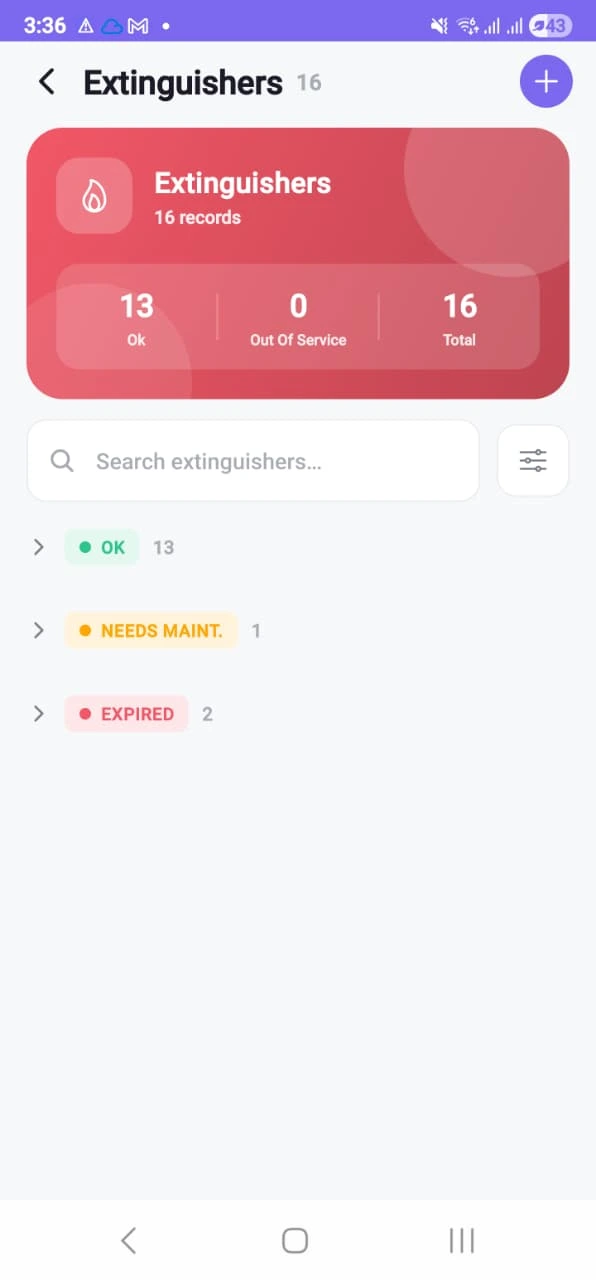
The extinguisher list on a phone: sixteen records with a counter strip, grouped into OK, needs maintenance and expired
The checklist

Ten checks, aligned to NFPA 10

Every step starts at OK and the inspector flags the exceptions. That is what keeps a compliant unit to seconds — and it is the difference between a checklist and a ritual.

  1. 01Located in designated place & unobstructed / visible
  2. 02Mounting bracket secure; signage visible
  3. 03Pressure gauge reads in the green / operable range
  4. 04Safety pin in place & tamper seal intact
  5. 05Discharge hose / nozzle free of cracks & blockage
  6. 06Body free of corrosion, dents or damage
  7. 07Operating instructions legible and facing outward
  8. 08Weight / fullness adequate (heft test)
  9. 09Inspection tag / service label present and up to date
  10. 10No signs of leakage or discharge

This is the monthly inspection, and only that. NFPA 10 also requires annual maintenance and periodic hydrostatic testing by a certified technician. No software performs either. What the platform does is record that they happened, track when the next one is due, and stop a unit quietly falling off the schedule between visits. Any vendor telling you otherwise is selling you a problem.

This list is the shipped default. The steps are configuration — an administrator edits them under System Settings → Inspections, so a site on a different standard, or a clean-agent unit that needs an extra check, is a settings change rather than a support ticket.

Follow-through

A failed check is a work order, not a note

This is the part that decides whether the module is worth anything. Finding a bad cylinder is easy; the question is what the finding turns into before everyone walks away.

FE-GAR-002

Clean Agent, 11 lbGary — Paint Booth

checked Aug 07 by Victor Ramos

8 of 10 checks passed. Two did not — and from across the bay this cylinder looked exactly like the ones either side of it.

  • Pressure gauge reads in the green / operable rangeGauge needle sitting below the green range
  • Inspection tag / service label present and up to dateService label missing — the last annual service cannot be confirmed

And then, on its own

The unit moved to

Needs maintenance

On the register, and on the mobile list under its own heading — no second entry, no email to the HSE inbox.

An action was raised

Service FE-GAR-002 — Paint Booth clean agent unit

Owner
Victor Ramos
Due
due Aug 12

Managers were notified with a severity, and the same unit will not raise a second action while the first is still open. An action list that repeats itself is an action list nobody reads.

The next inspection was scheduled for Sep 06, 30 days on. Nobody had to remember any of it — which is the only version of this that survives a busy month.

The cycle

What the round looks like, every month

Eight steps, of which the custodian does three. The rest is the platform doing the remembering — which is the part a busy month reliably destroys.

  1. 1

    The due date arrives

    The unit surfaces on its custodian’s list for the day. Nobody keeps a spreadsheet of due dates, and nobody discovers the round by walking past a wall planner.

  2. 2

    Scan the tag

    The QR label on the cylinder opens that extinguisher — not the one beside it. On a wall of near-identical red cylinders this is the difference between a record and a guess.

  3. 3

    Ten checks

    Every step starts at OK. The inspector flags the exceptions, so a compliant unit takes seconds and a bad one takes as long as it needs.

  4. 4

    Photograph the exception

    Evidence attaches to the step that failed. A photograph of a gauge below the green is a record; “pressure looked low” is a recollection.

  5. 5

    The status resolves itself

    A clean check leaves the unit OK. Any failure moves it to Needs maintenance, on the register, without a second data entry.

  6. 6

    An action is raised and owned

    Assigned to the custodian with a due date and chased when it runs late. A unit already in a problem state raises no second action, so the list stays worth reading.

  7. 7

    The next check is scheduled

    Thirty days from this inspection by default, counted forward automatically. The interval is configurable per unit for sites that run a different cycle.

  8. 8

    The record is retained

    Every past inspection stays on the unit, exportable as a report carrying the QR tag and the full history — for the file, or for the fire marshal.

Escalation

A unit that misses its date raises its own work

When a next-due date passes, the extinguisher flips to Expired on its own, a corrective action is raised against its custodian, and a notification goes to managers. Nobody ran a report to find these two.

Overdue as at · illustrative

  • FE-HOU-003Expired

    Carbon dioxide, 15 lb

    Houston — Maintenance Shop

    Last checked
    Was due
    · 8 days late

    Action raised against James Okonkwo

  • FE-BR-003Expired

    Carbon dioxide, 10 lb

    Baton Rouge — Drum Storage

    Last checked
    Was due
    · 3 days late

    Action raised against Derek Coleman

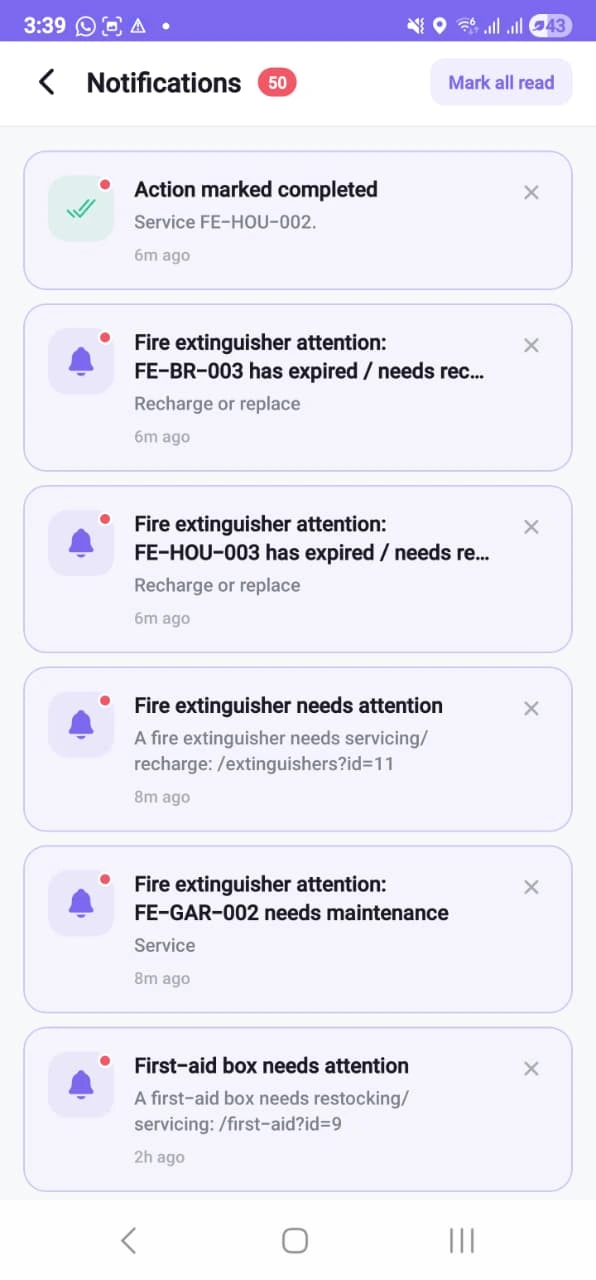
The notifications list on a phone: two extinguishers flagged as expired and needing recharge or replacement, one flagged as needing maintenance, a first-aid box needing restocking, and an action marked completed
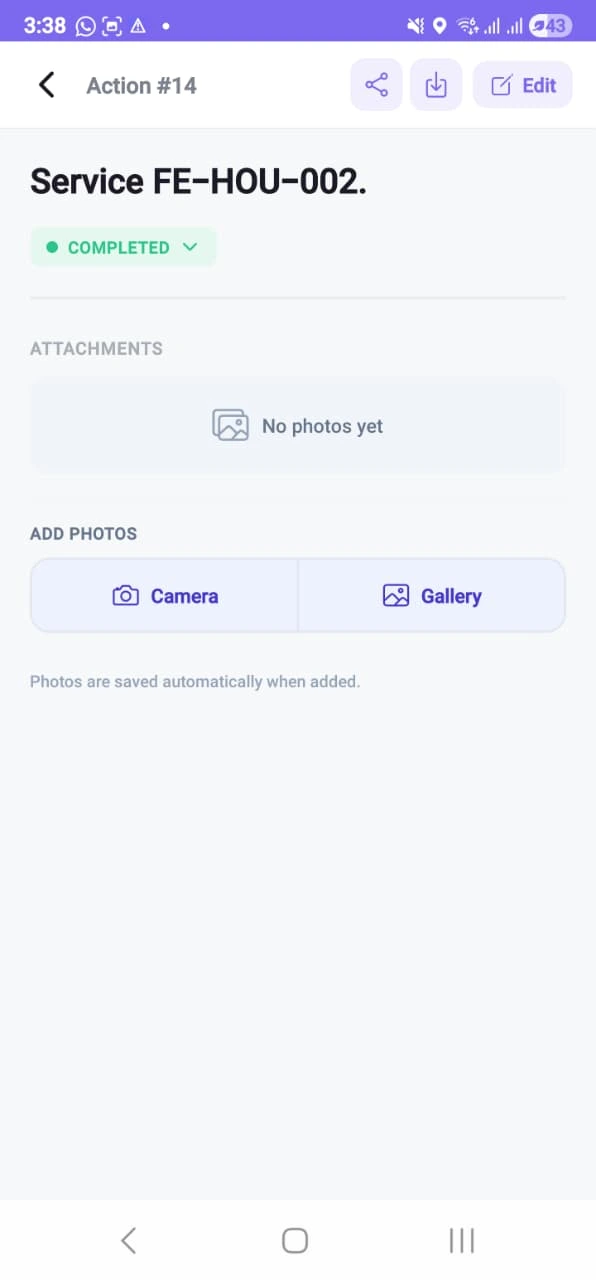
A corrective action on a phone titled Service FE-HOU-002, marked completed

The loop, from both ends

Each overdue unit names itself in the notification — which cylinder, and what it needs. Recharge or replace for the two that expired, service for the one that failed its gauge check. A manager reads a queue of specific units, not a digest telling them something somewhere needs attention.

And the loop closes in the same place. The action beside it is the one at the top of that list, already completed — a different unit, earlier in the month, closed out and reported back. The same object type the Paint Booth failure creates.

Worth being plain about the limit: the platform can tell you a cylinder is overdue, put a name against it and keep asking. It cannot recharge it, and it cannot make somebody walk to the bracket. What it removes is the excuse that nobody knew.

The register itself

Adding a cylinder is a job for the person standing next to it

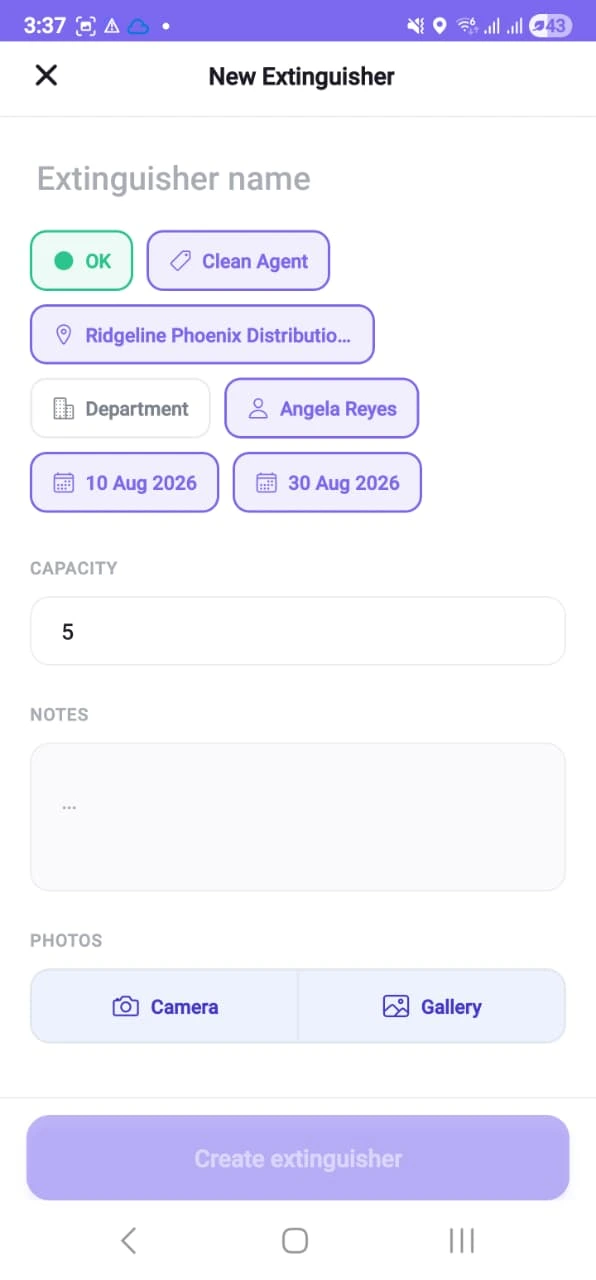
Type, status, location, custodian and both dates are pickers on a phone. Commissioning a new bay does not require a laptop, and correcting a wrong custodian does not require a support ticket.

The new extinguisher form on a phone: name, status, type, location, department, custodian, both inspection dates, capacity, notes and photo buttons
Adding a unit: every field a picker, and the next inspection date already set.
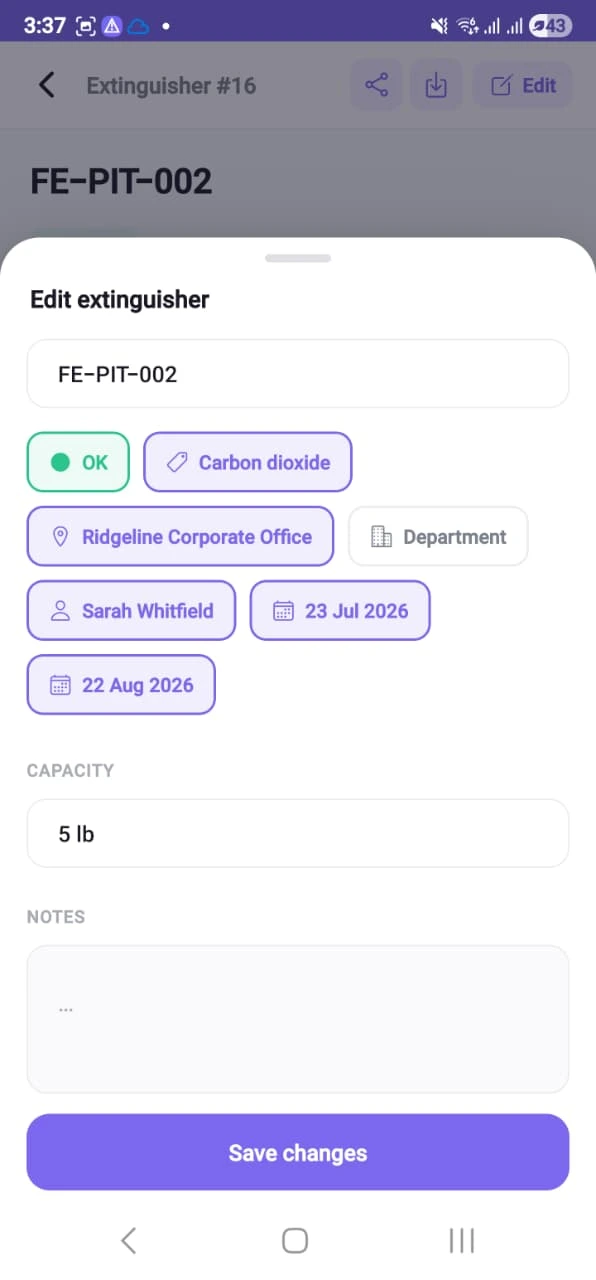
The edit extinguisher sheet on a phone, showing the asset code, status, type, location, custodian, dates, capacity and notes as editable fields
Editing one: the same fields, changed at the bracket rather than requested by email.

Seven types, editable

Carbon dioxide, Dry Powder, Foam, Water, Wet Chemical, Clean Agent and whatever else you carry. Types are a lookup an administrator edits, not a list compiled into the product.

Four states, one meaning

OK, Needs maintenance, Expired, Out of service. The same colour means the same thing on the register, the phone and every export — so nobody has to ask what amber meant.

Tags print in bulk

A sheet for a whole site rather than one label at a time. Commissioning a new building is an afternoon with a printer, not a data-entry project.

One open action per unit

A cylinder that stays in a problem state raises exactly one action, not one every time somebody loads the page. A list that repeats itself is a list nobody reads.

Approval is a workflow

Records can be routed for sign-off, and the approved status is set by the workflow rather than typed in by the person who wants it approved.

A report per cylinder

A PDF carrying the QR tag and the full inspection history — for the file, or for the fire marshal standing in front of that unit asking about it.

Evidence

What a fire marshal actually asks for

Buyers respond to clause numbers rather than feature lists, because the clause is the artefact they have to produce on the day.

  • NFPA10

    Monthly inspection of portable fire extinguishers

    Where the evidence comes from

    The 10-point checklist, dated and attributed, retained per unit

  • NFPA10

    Annual maintenance and hydrostatic test intervals

    Where the evidence comes from

    Recorded per unit with the next date tracked — performed by your technician, not by us

  • OSHA1910.157(e)

    Extinguishers inspected monthly and the records retained

    Where the evidence comes from

    Inspection record with the inspector, the date and the findings, exportable

  • OSHA1910.157(c)

    Mounting, location and identification

    Where the evidence comes from

    Location and area on the record, plus the accessibility and signage checks

  • ISO 45001:20188.2

    Emergency preparedness & response

    Where the evidence comes from

    Equipment readiness evidenced on a schedule rather than asserted at audit time

  • ISO 45001:20187.5

    Documented information

    Where the evidence comes from

    Every inspection retained and retrievable, by unit or by site

SentinelHSE supports evidencing these requirements. Certification is an audit of your organisation, not of software — and the annual service behind two of these rows is performed by your technician, with the platform recording that it happened.

Objections

The six things you are already thinking

Answered the way we would answer them in the room, including where the boundary is real.

A punched tag proves somebody was there with a punch. It does not record a pressure reading, it does not survive the cylinder being repainted or swapped out, and it cannot tell you this morning which of your 16 units are overdue — you would have to walk to all of them to find out. Here that is a filter, and the two overdue ones already have a name against them.

No, and be suspicious of anyone who says otherwise. NFPA 10 requires annual maintenance and periodic hydrostatic testing by a certified technician, and no software performs either. What the platform does is run the monthly inspection, record that the annual service happened and when the next one is due, and stop a unit quietly falling off the schedule between visits.

Whoever owns the unit. Each one carries a named custodian, the due list goes to them, and so does the overdue chase — which is the part that decides whether this works at all. A register owned by “Maintenance” is a register nobody owns.

The 10 steps are the shipped default, aligned to NFPA 10's monthly inspection. An administrator edits them under System Settings → Inspections. Different steps for a clean-agent unit in a server room than for a dry powder in a weld bay is normal, and it is configuration rather than a development ticket.

The inspection is captured at the cylinder and syncs when the phone finds a bar. That matters here because extinguishers live in the places with no reception — plant rooms, tank farms, basements — and an inspection you have to walk somewhere to submit is an inspection that gets typed up from memory later.

Yes. It can run in our cloud, inside your own cloud account under your policies and retention rules, or entirely on your own servers. Everything exports, so leaving stays a decision you can make later.

See it on your own data

Send your extinguisher list — a spreadsheet is fine. We'll load it, print the QR tags, and show you which units are overdue today.

45 minutes. In the illustrative register above, thirteen of sixteen units are in date and three need somebody — including two that are past their date.