Skip to content
SentinelHSE
Risk assessment & JHA

Every risk assessment claims the risk came down. This one makes you say what by.

Initial and residual risk on one configurable matrix, with the reduction refused unless the controls behind it are written down — and a review date the platform actually chases.

#21 · Work at Height

Contractor roof work — HVAC replacement

Initial15CriticalL3 × C5
Initial risk for Contractor roof work — HVAC replacement: likelihood 3 by consequence 5.
Likelihood down, consequence across12345
5510152025
448121620
33691215Initial risk, Critical
2246810
112345

Likelihood down the side, consequence across. Initial sits at L3 × C5, ringed above.

Residual10HighL2 × C5
Residual risk for Contractor roof work — HVAC replacement after the recorded controls: likelihood 2 by consequence 5.
Likelihood down, consequence across12345
5510152025
448121620
33691215
2246810Residual risk, High
112345

Likelihood down the side, consequence across. Residual sits at L2 × C5, ringed above.

Illustrative data — not a customer.

The two failure modes an auditor finds in twenty minutes

A residual rating with nothing behind it

Initial risk 25, residual risk 1, controls field empty or reading “care to be taken”. It is not fraud — it is a form being filled in at the end of a Friday. And it is the assessment that gets read out in an inquiry, because the drop from 25 to 1 is a claim the organisation made in writing and cannot support.

And then the date

Almost every register has a review date column and almost no system does anything with it. The assessment was right when the line ran a different product, before the guard was modified, before the crew turned over. Nobody decided to let it lapse; nothing was watching.

The refusals

Three things the platform will not record, however the form is filled in

Quoted as the product says them, because a refusal you can read is one a sceptic can test.

01A reduction with nothing behind it

This brings the risk down from 25 to 2 without recording a single control. Write down what does it — existing controls, further controls required, or both. A reduction nobody can name is the first thing an auditor asks about.

Initial risk 25, residual risk 1, controls field empty or reading “care to be taken”. It is not fraud, it is a form being filled in at the end of a Friday — and it is the assessment that gets read out in an inquiry.

02A residual worse than where you started

The residual risk (25) is higher than the initial risk (1). Residual risk is what remains after the controls, so it can’t be worse than where you started — check the likelihood and consequence aren’t the wrong way round.

Nearly always a transposed pair, and it leaves the worst-looking residual risks on site being ones nobody assessed as bad.

03A square that does not exist

Likelihood must be between 1 and 5 — the site’s risk matrix is 5×5. Got 99.

Nor is zero a score, which used to be stored happily and then rendered as an em-dash.

And it can’t be slipped in afterwards: the rule is checked against the record as it will be, not just the fields in the request, so adding a residual in a second save still needs the controls.

One scale

A score of 15 has to be called the same thing everywhere

A risk matrix is a shared vocabulary. The moment two parts of a system band the same number differently, the vocabulary is gone.

So the bands are defined once, server-side, and published — the register, the exported PDF, the notification and the field app all ask for them rather than carrying a copy.

They are expressed as fractions of the matrix maximum, so a site running 4×4 or 3×3 gets a scale that reaches Critical instead of one calibrated for somebody else’s grid.

Band thresholds computed from the matrix size, for 3×3, 4×4 and 5×5 grids.
MatrixMediumHighCriticalMax
3×32469
4×4471016
5×5This site5101525

Every number in that table is computed from the matrix size rather than typed, and the build fails if the function and the printed scale ever disagree. On a scale hardcoded for 5×5, a 3×3 site could never reach the top band at all — which was a real bug rather than a hypothetical one.

And while we are being precise about vocabulary

The hierarchy of controls, in the order that matters:

  1. EliminationTake the hazard out of the job. The only one that cannot fail.

  2. SubstitutionUse something less harmful to do the same work.

  3. EngineeringGuard it, enclose it, ventilate it, interlock it. Works while nobody is thinking about it.

  4. AdministrativeProcedures, permits, training, rotation. Depends on people doing it every time.

  5. PPEThe last line, protecting one person, and only while it is worn correctly.

This platform is on none of those rungs. It records which controls were chosen, who owns the ones still outstanding, and whether the reduction they claim is supported. Software does not guard a machine.

Worked example

Contractor roof work: 15 before, 10 after, and that is the honest answer

The one that stays amber, which is exactly why it is the one on this page.

Initial · L3 × C5 = 15

Contractor removing and replacing roof-mounted air handling units. Four on the roof, staff below the lift zone.

Controls

Contractor pre-qualified and inducted; method statement and lift plan accepted before mobilisation. Perimeter guardrail to the work area. Exclusion zone below, barriered and marshalled during lifts. Permit issued daily and closed each evening.

Further controls required

Certified fall-arrest anchor points — the current plan relies on temporary guardrail alone.

Owner: Derek Coleman · Target: 30 Jun 2026

Residual · L2 × C5 = 10

High

The consequence didn’t move, and it shouldn’t have

Nothing on that list changes what happens when somebody comes off a roof. The controls change how likely it is to happen — likelihood 3 down to 2, consequence unmoved at 5.

A register where every residual lands on green is a register that has stopped modelling anything. Here, 8 of 14 are still Medium or above after every control on the record — and the ones that stay amber after every reasonable control are precisely the ones worth a manager’s attention.

Before controls

Low
0
Medium
4
High
5
Critical
5

What the register counts at the top · n = 14

After controls

Low
6
Medium
6
High
2
Critical
0

What is actually left · n = 14

Worth knowing which one you are reading: the counters at the top of the register band by initial risk — the risk before anybody did anything. Fair to count, misleading on its own, so both are on this page.

Risk register

Likelihood × consequence, with residual risk after controls

Illustrative data — not a customer

By initial risk — before any control

0

Low0

4

Medium0

5

High0

5

Critical0

  • #26

    Lone working — night shift roundsSingle operator patrolling the plant on nights

    Type
    Occupational Health
    Initial risk
    Medium9
    Residual risk
    Low4
    Next review
    194d left
  • #25

    Arc flash — MCC 2 switchingRacking breakers and switching on the 480 V motor control centre

    Type
    Electrical
    Initial risk
    High10
    Residual risk
    Medium5
    Next review
    252d left
  • #24

    Diesel spill to storm drain — bulk fillRefuelling site plant from the bulk tank

    Type
    Environmental
    Initial risk
    Medium9
    Residual risk
    Low4
    Next review
    216d left
  • #23

    Ergonomics — inspection benchRepetitive visual inspection and small-part assembly

    Type
    Occupational Health
    Initial risk
    Medium6
    Residual risk
    Low4
    Next review
    227d left
  • #22

    Legionella — cooling towerOperation and maintenance of the evaporative cooling tower

    Type
    Occupational Health
    Initial risk
    High10
    Residual risk
    Medium5
    Next review
    54d left
  • #21

    Contractor roof work — HVAC replacementContractor removing and replacing roof-mounted air handling units

    Type
    Work at Height
    Initial risk
    Critical15
    Residual risk
    High10
    Next review
    40d overdue
  • #20

    Hot work — maintenance bay pipe repairWelding and grinding on process pipework in the shop

    Type
    Fire & Explosion
    Initial risk
    High12
    Residual risk
    Low4
    Next review
    due in 23d
  • #19

    Manual handling — drum stock rotationMoving and up-ending 205 L drums in the store

    Type
    Manual Handling
    Initial risk
    Medium8
    Residual risk
    Low4
    Next review
    262d left
  • #18

    Noise exposure — compressor houseRoutine attendance in the compressor house during running

    Type
    Occupational Health
    Initial risk
    High12
    Residual risk
    Medium6
    Next review
    275d left
  • #17

    Lockout/tagout — packaging line 3Clearing jams and changing format parts on the bagger

    Type
    Mechanical
    Initial risk
    High12
    Residual risk
    Low4
    Next review
    284d left
  • #16

    Forklift and pedestrian interaction — Warehouse APallet movements across the pick face during shift handover

    Type
    Vehicle & Traffic
    Initial risk
    Critical16
    Residual risk
    Medium8
    Next review
    20d overdue
  • #15

    Confined space entry — effluent sump S-2Inspection, cleaning and lining repair inside the effluent sump

    Type
    Confined Space
    Initial risk
    Critical15
    Residual risk
    High10
    Next review
    due in 12d
  • #14

    Overhead crane lifts across the pick faceMoving finished coil from the bay to the despatch pad

    Type
    Lifting Operations
    Initial risk
    Critical15
    Residual risk
    Medium5
    Next review
    303d left
  • #13

    Caustic transfer — bulk IBC to day tanksDecanting 32% sodium hydroxide from the bulk IBC

    Type
    Chemical
    Initial risk
    Critical16
    Residual risk
    Medium8
    Next review
    86d overdue

Showing 14 of 14. Every row carries both numbers, because the residual on its own is a claim with nothing to compare it to — and the drop between them is the thing an auditor asks you to justify.
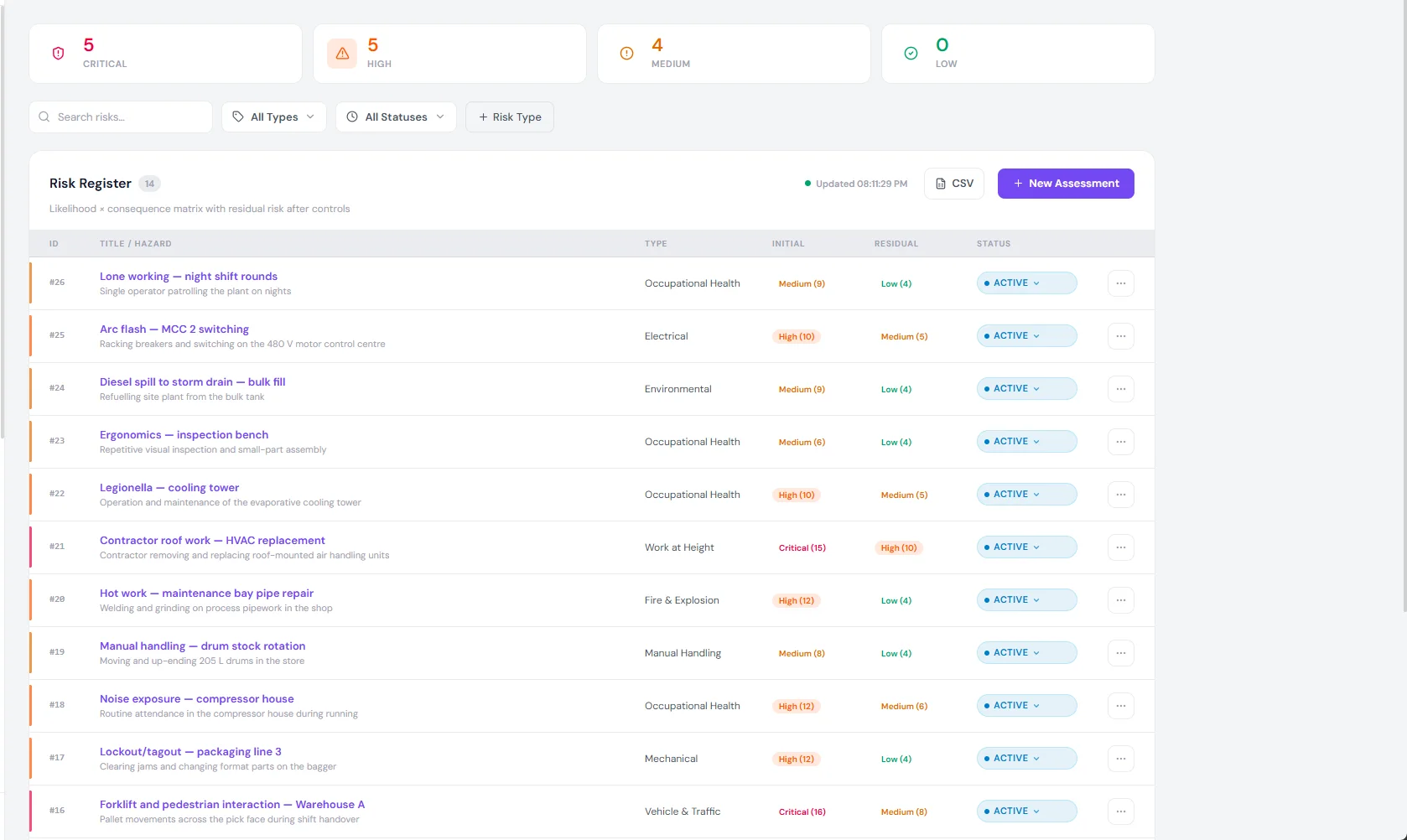
The risk register showing fourteen assessments with their type, initial risk score, residual risk score and status.
Both scores on every row, in the product. Illustrative data — not a customer.
The review clock

An assessment nobody revisits is the finding an auditor opens with

Every assessment and every JHA carries a next review date. The platform reads it.

Overdue for review

3

The worst of them is #13 Caustic transfer — bulk IBC to day tanks, 86 days past its date at an initial rating of 16. Nobody decided to let that lapse.

Due within 30 days

2

Both counts are filters on the register above, not a report somebody runs monthly.

  1. 30 days out

    The owner is told once, when it comes into the window. Not before, because a reminder that arrives three months early is one nobody acts on.

  2. On the date

    The record starts counting days rather than showing a date, and the register’s overdue filter picks it up.

  3. Monthly while overdue

    Once a month, not every fifteen minutes until they mute it. The row stays overdue whether or not anybody is still being told.

  4. On edit

    Changing the review date resets the chase, because that is what reviewing it means.

JHA

The analysis, not the cover sheet

A job broken into steps in the order it is done, each with what could hurt somebody and what stops it.

Job hazard analysis · Baton Rouge — Drum Storage

Replace the mechanical seal on caustic transfer pump P-101

7 steps, in the order the job is done · owner Marcus Delgado

The 7 steps of Replace the mechanical seal on caustic transfer pump P-101, each with its hazards and the controls against them.
Step numberStepWhat could hurt somebodyWhat stops it
1Isolate and lock off P-101, prove deadStored energy; unexpected start-upPersonal lock applied by each person working; try-start test at the panel before any tool is picked up.
2Drain and flush the casing to the closed systemResidual process fluid under head; caustic burnsDrain to the closed catch pot, never to the bund; face shield and chemical gauntlets; stand upwind of the vent.
3Break the flangesTrapped pressure behind the seal; jet release when the joint cracksCrack the joint on the far side first and let it vent; nobody in line with the split; tray under the joint.
4Lift the pump head clear to the benchManual handling; dropped load in a narrow aisleGantry lift with two people, aisle barriered at both ends, nobody under the load at any point.
5Withdraw and replace the mechanical sealSharp edges on the shaft sleeve; residual caustic in the seal chamberGauntlets stay on until the chamber is flushed and swabbed; cut-resistant gloves for handling the sleeve.
6Rebuild, torque to sequence, refit the coupling guardGuard left off; incorrect torque leading to a leak under pressureTorque wrench and the sequence card at the job; the guard goes back before the isolation comes off, not after.
7Remove locks and prove seal integrity at pressureJet release on first pressurisationArea cleared before the start; watch from outside the spray line for the first two minutes; the permit stays open until it holds.

PPE required

  • Chemical splash goggles and face shield
  • Chemical gauntlets
  • Cut-resistant gloves (step 5 only)
  • Chemical-resistant apron
  • Safety footwear
  • Hard hat (step 4, under the gantry)

“Isolate, drain, purge, open” is a different job from “open, drain, purge, isolate”. The steps come back in the sequence they were written, and are reorderable when the job changes — not sorted by anything the database finds convenient. Illustrative data — not a customer.

Where it is read

At the job, on a phone, by the crew about to do it

A JHA in a binder in the site office is a document. A JHA the fitter opens at the pump is a control.
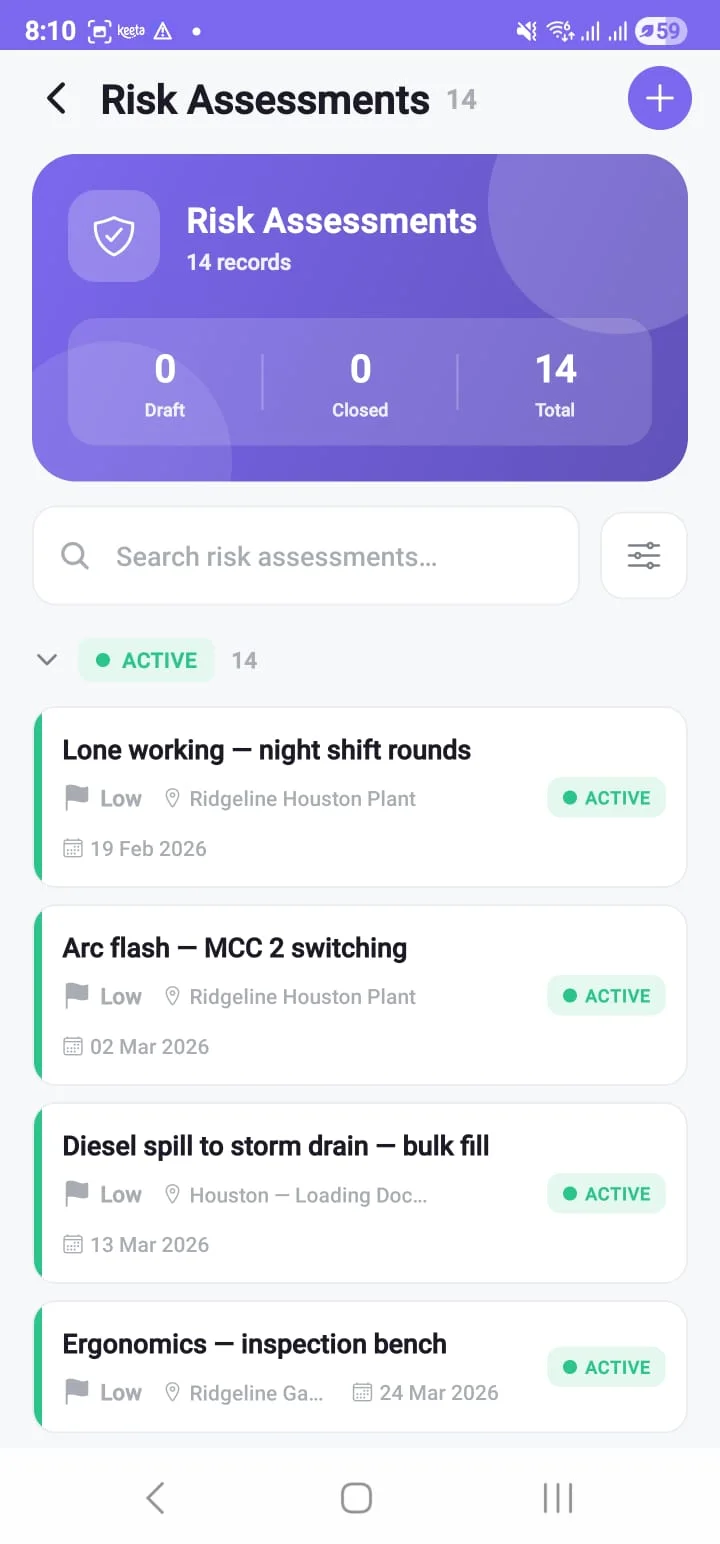
The risk assessment register on the field app, showing fourteen records with their location and date.
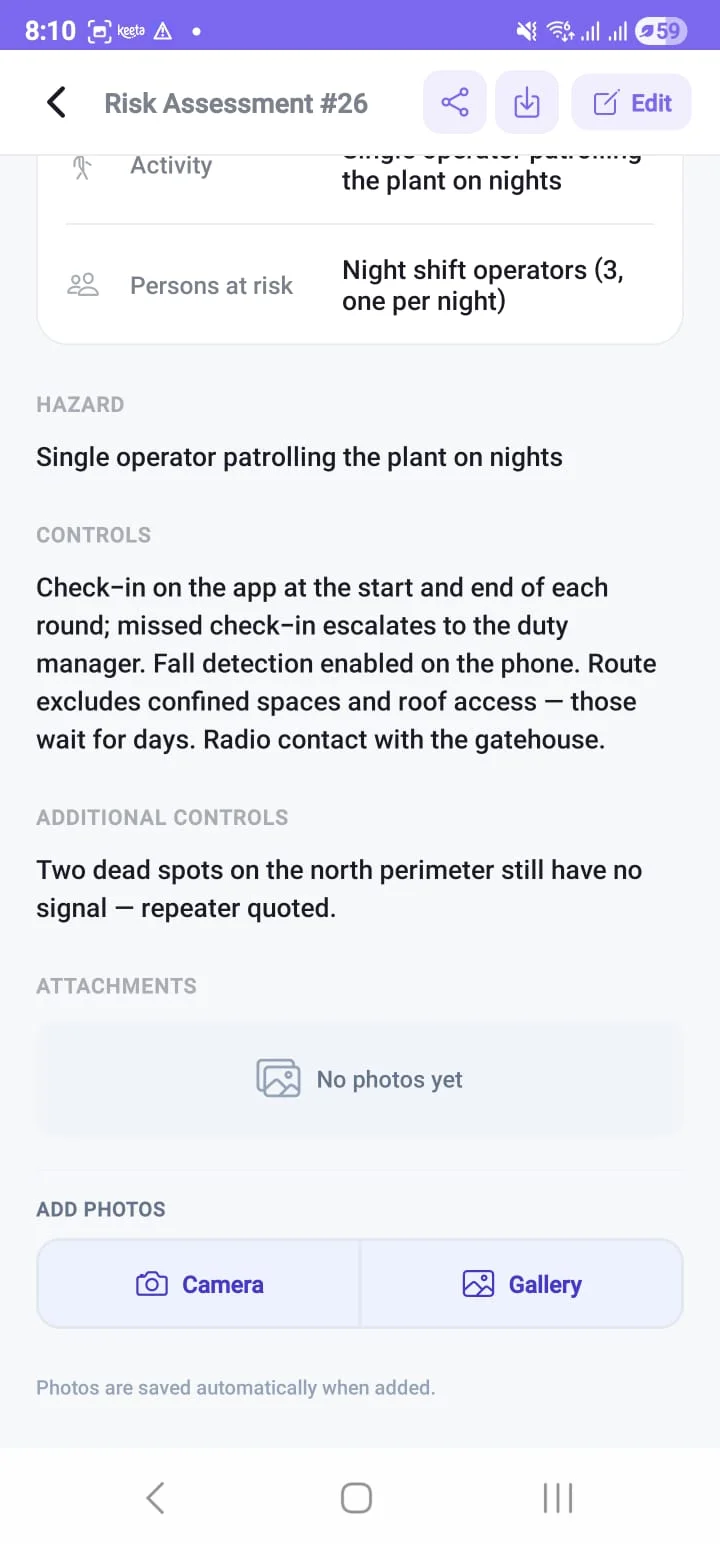
A risk assessment open on the field app, showing the hazard, the existing controls and the additional controls still required.

The step that turns out to be missing

It is discovered standing in front of the work, thirty seconds before the first spanner — so it gets added there, rather than remembered later and not added at all. Both directions on the same record the office sees.

And a control we would argue with

Read #26 on the phone above. Its controls include app check-in with escalation on a missed round — and that is a control, an administrative one: the control is the requirement to check in and what happens when you do not. The platform is only how it is administered.

The line on that record we would push back on is fall detection on the handset. A detector tells somebody after. It belongs in the emergency response section, not in the column claiming the risk came down.

Further controls are on the record, not in a plan somewhere else

Two dead spots on the north perimeter still have no signal — repeater quoted.” — with a named owner and a target date, which is the difference between an outstanding control and an intention.

End to end

Seven steps, and the last one starts the first again

  1. Assess

    The activity, who is at risk, and likelihood × consequence before anybody does anything about it.

  2. Control

    What is already in place, what still has to be done, who owns it and by when.

  3. Rate what’s left

    Residual risk — refused unless the controls behind the reduction are named on the record.

  4. Sign off

    Optional named approval before it goes live, on the same workflow every other sign-off runs on.

  5. Break it into steps

    The JHA the crew actually works from, in the order the job is done.

  6. Brief it

    As a toolbox talk, with the crew signing on — the briefing is a record, not an announcement.

  7. Review

    On the date, chased, and the cycle restarts. Editing the date resets the chase.

Sign-off runs on the same workflow every other approval on the platform uses — named signers, in order, nobody signing their own request.

Approvals & e-signatures

Hazard reports run their own 4×5 severity × likelihood scale with an Extreme top band. Different register, different question — a hazard is something somebody saw, an assessment is an activity somebody rated.

Hazard reporting
Compliance map

What an auditor asks, and what you hand them

Clause by clause, the record this module produces — not a claim that it makes you compliant.

  • 6.1.2

    Hazard identification & risk assessment

    What the assessment hands over

    The register itself — every activity, who is at risk, and both ratings

  • 8.1.2

    Hierarchy of controls

    What the assessment hands over

    Controls recorded against the hierarchy, with the residual rated after them rather than instead of them

  • 8.1.3

    Management of change

    What the assessment hands over

    Re-assessment when the job, the plant or the people change — and a review date that chases it

  • 7.5

    Documented information

    What the assessment hands over

    Every version retained, with who changed what and when

  • 9.1

    Monitoring, measurement & analysis

    What the assessment hands over

    Overdue-review counts and the residual-risk profile, as a monitoring output

  • ISO 45001 9.3

    Management review

    What the assessment hands over

    The residual-risk profile and the overdue count as a review input, with both numbers stated

  • ISO 31000:2018

    Risk management guidelines

    What the assessment hands over

    The assess / treat / monitor cycle this module implements, end to end

  • OSHA 29 CFR 1910.132(d)

    Hazard assessment for PPE

    What the assessment hands over

    PPE recorded on the JHA against the step that needs it, not as a blanket list

Sentinel supports evidencing these requirements. Certification is an audit of your organisation, not of software. The matrix, its bands and the review periods are yours to configure — your own risk criteria are the authority, not this page.

Objections

The seven things you are already thinking

Set the size and the bands scale with it — they are fractions of the maximum rather than fixed numbers, so a 4×4 site gets Medium at 4, High at 7 and Critical at 10 instead of a scale calibrated for somebody else's grid. That matters more than it sounds: on a scale built for 5×5, a 3×3 site could never reach the top band at all, which is exactly the bug this replaced.

Then it is not residual risk — it is a different activity with its own assessment. Residual is what remains after the controls on this record, so it cannot be worse than where the same activity started. In practice this refusal catches a transposed likelihood and consequence about nine times out of ten, and the tenth is a job that had quietly changed into a different job.

Yes, and expect some rows to fail the residual rule on the way in. Those are the ones worth your afternoon — a row that drops from 20 to 2 with an empty controls field is not an import problem, it is the assessment you would least like read out in an inquiry, and the import is the cheapest time you will ever find it.

Whoever holds the permission, with every change attributed and retained. Where a change needs signing off before it takes effect, put an approval workflow on the record — that is a separate module and it applies here the same way it applies to a permit or a corrective action.

To open a JHA on the phone at the job, yes. To be briefed on it as a toolbox talk and sign on, no — the briefing records attendance without every attendee needing a login, which matters when half the crew is a contractor’s.

No. It tells the owner, keeps telling them monthly while it is overdue, and shows it in the register under an overdue filter. Locking a document people need at the job is how people stop using the system and start keeping a copy in a drawer, and a copy in a drawer is the failure this module exists to prevent.

Yes, including on your own infrastructure. The harder question, and the one worth more of your time, is which of your people can change a live assessment and whether that change is attributed — which is the permissions and audit answer above rather than a hosting region.

14 assessments, a 5×5 matrix banding Medium at 5, High at 10 and Critical at 15, and a 7-step JHA — all illustrative, from a demonstration register rather than a customer.

Bring us your worst register.

Send the sheet you’d least like an auditor to open. We’ll load it and show you which rows claim a reduction with nothing behind them, and which ones lapsed. That conversation is the demo.

Forty-five minutes, your register, no slides.