The observations you never hear about are the ones that were about people.
A safety-observation channel that records what went right as readily as what went wrong — because the moment it only does the second, it stops receiving either.
An empty observation log is not a safe site. It is a quiet one.
Conditions get reported because a broken thing has no feelings. Acts do not, because reporting one means writing down something a colleague did, and everybody on site already knows how that has gone before.
So the log fills with damaged extension leads and blocked exits. And the shortcut across the reversing area — the one that will actually kill somebody — is written down by nobody.
This is the one module that dies if it feels punitive. Not slowly — inside a quarter.
Count the acts. Then count the positives.
Two ratios tell you whether the channel works, and neither is the total. A rising count means more looking, not a worse site.
28 observations, by type
One working month. The split matters more than the total.
- Unsafe act
- 6
- Unsafe condition
- 14
- Positive
- 6
- Near miss
- 0
- Environmental
- 2
- Other
- 0
6 vs 14
Acts vs conditions
Conditions alone means people will report objects but not each other. A broken extension lead has no feelings; a colleague does.
6 of 28
Positive vs negative
If nothing good is ever recorded, the channel reads as a disciplinary tool and dries up inside a quarter.
Six unsafe acts against fourteen conditions, and six records of somebody doing the right thing. The six positives are not padding — they are why the six acts were filed at all.
28 observations in one month
A live observation programme from a working month. Search the text of the root causes, which is where the useful answers are.
Observation board
One working month, acts first
| Type | Observation | Area | Severity | Owner | Target | Status |
|---|---|---|---|---|---|---|
| Unsafe act | Standing on a pallet to reach the top rack | Houston — Warehouse A | Critical | James Okonkwo | Aug 06 | Closed |
| Unsafe act | Operator crossing the yard outside the marked walkway | Houston — Loading Dock 3 | High | Marcus Delgado | Aug 15 | In progress |
| Unsafe act | Grinding without a face shield at the fettling bench | Gary — Weld Bay 2 | High | Victor Ramos | Aug 10 | Closed |
| Unsafe act | Chemical decanted without gloves in the plating area | Houston — Chemical Yard | High | Emily Carver | Aug 08 | Closed |
| Unsafe act | Mobile phone in use while operating the pallet truck | Houston — Warehouse A | Medium | Robert Pierce | Aug 13 | In progress |
| Unsafe act | Ear defenders removed inside the press-line hearing zone | Ridgeline Houston Plant | Medium | Priya Natarajan | Aug 07 | Closed |
| Unsafe condition | Emergency exit route obstructed by pallets | Houston — Warehouse A | Critical | Robert Pierce | Aug 09 | Closed |
| Unsafe condition | Guard rail loose on the mezzanine walkway | Houston — Warehouse A | Critical | Anthony Russo | Jul 31 | Approved |
| Unsafe condition | Dust extraction underperforming at the cut-off saw | Gary — Weld Bay 2 | High | Priya Natarajan | Jul 25 | Open15d overdue |
| Unsafe condition | Missing machine guard interlock test records | Ridgeline Houston Plant | High | Anthony Russo | Jul 24 | In progress16d overdue |
| Unsafe condition | Reversing camera inoperative on shunter SH-02 | Phoenix — Dock Apron | Medium | James Okonkwo | Jul 28 | Open12d overdue |
| Environmental | Bund level rising at the tank farm | Baton Rouge — Tank Farm B | High | Derek Coleman | Aug 03 | Closed |
| Positive | Crew stopped work to re-plan a lift | Ridgeline Gary Fabrication | — | Victor Ramos | — | Closed |
| Positive | Contractor challenged a permit that did not match the work | Ridgeline Houston Plant | — | Anthony Russo | — | Closed |
| Positive | Driver refused to load an unsafe trailer | Houston — Loading Dock 3 | — | Marcus Delgado | — | Closed |
- Unsafe actClosed
Standing on a pallet to reach the top rack
- Area
- Houston — Warehouse A
- Severity
- Critical
- Owner
- James Okonkwo
- Target date
- Aug 06
- Unsafe actIn progress
Operator crossing the yard outside the marked walkway
- Area
- Houston — Loading Dock 3
- Severity
- High
- Owner
- Marcus Delgado
- Target date
- Aug 15
- Unsafe actClosed
Grinding without a face shield at the fettling bench
- Area
- Gary — Weld Bay 2
- Severity
- High
- Owner
- Victor Ramos
- Target date
- Aug 10
- Unsafe actClosed
Chemical decanted without gloves in the plating area
- Area
- Houston — Chemical Yard
- Severity
- High
- Owner
- Emily Carver
- Target date
- Aug 08
- Unsafe actIn progress
Mobile phone in use while operating the pallet truck
- Area
- Houston — Warehouse A
- Severity
- Medium
- Owner
- Robert Pierce
- Target date
- Aug 13
- Unsafe actClosed
Ear defenders removed inside the press-line hearing zone
- Area
- Ridgeline Houston Plant
- Severity
- Medium
- Owner
- Priya Natarajan
- Target date
- Aug 07
- Unsafe conditionClosed
Emergency exit route obstructed by pallets
- Area
- Houston — Warehouse A
- Severity
- Critical
- Owner
- Robert Pierce
- Target date
- Aug 09
- Unsafe conditionApproved
Guard rail loose on the mezzanine walkway
- Area
- Houston — Warehouse A
- Severity
- Critical
- Owner
- Anthony Russo
- Target date
- Jul 31
- Unsafe conditionOpen15d overdue
Dust extraction underperforming at the cut-off saw
- Area
- Gary — Weld Bay 2
- Severity
- High
- Owner
- Priya Natarajan
- Target date
- Jul 25
- Unsafe conditionIn progress16d overdue
Missing machine guard interlock test records
- Area
- Ridgeline Houston Plant
- Severity
- High
- Owner
- Anthony Russo
- Target date
- Jul 24
- Unsafe conditionOpen12d overdue
Reversing camera inoperative on shunter SH-02
- Area
- Phoenix — Dock Apron
- Severity
- Medium
- Owner
- James Okonkwo
- Target date
- Jul 28
- EnvironmentalClosed
Bund level rising at the tank farm
- Area
- Baton Rouge — Tank Farm B
- Severity
- High
- Owner
- Derek Coleman
- Target date
- Aug 03
- PositiveClosed
Crew stopped work to re-plan a lift
- Area
- Ridgeline Gary Fabrication
- Severity
- —
- Owner
- Victor Ramos
- Target date
- —
- PositiveClosed
Contractor challenged a permit that did not match the work
- Area
- Ridgeline Houston Plant
- Severity
- —
- Owner
- Anthony Russo
- Target date
- —
- PositiveClosed
Driver refused to load an unsafe trailer
- Area
- Houston — Loading Dock 3
- Severity
- —
- Owner
- Marcus Delgado
- Target date
- —
Showing 15 of 15 rows — fifteen of 28 observations in the month. The mezzanine guard rail is three weeks past its target date and carries no overdue badge, because it has been signed off. A tracker that chases accepted work teaches people to ignore it.
Six of the 28 are past their target date, and three of those are in the extract above. That is the honest state of most registers. The difference is that here they are counted on the board rather than discovered in an escalation email — and the count, the tinted rows and the past-target filter are the same number, which you can click and count.
Nobody files a report about a colleague on a channel that only punishes.
Contractor challenged a permit that did not match the work
A contractor refused to start hot work because the permit described a different location, and asked for it to be reissued.
Permit withdrawn and reissued against the correct location before work began. Raised at the contractor forum as the standard expected.
That record costs nothing and does more for the reporting rate than any campaign. It tells every person who reads the board that this channel is for what happened, not for who is at fault — which is the only condition under which the next person writes down the shortcut across the reversing area.
“Sorted it” is not a corrective action
Most systems have one box and collect the second answer. The fourth explains why it happens again next month.
What was observed
Two operators cutting diagonally across the yard, passing behind a reversing trailer.
The thing itself, written where it was seen. Not a judgement about anybody.
What was done at the time
Both stopped and spoken to; shift briefed the same morning.
Necessary, immediate, and the answer most systems stop at.
What is recommended
Re-mark the walkway and add a barrier at the desire line.
This one becomes a dated, owned row on the corrective-action board.
Root cause
The marked walkway adds ninety seconds. The shortcut is faster and has been tolerated.
The field an auditor asks for, and the only one that explains why this will be filed again next month.
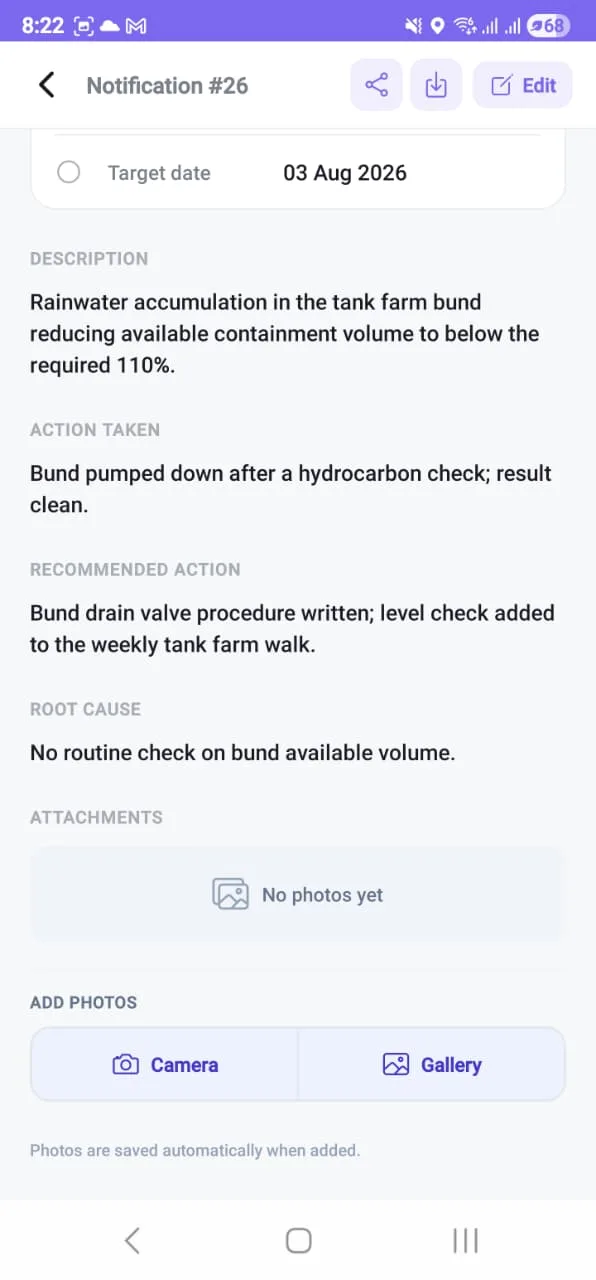
The same four fields, on a real record
Observation #26, filed by Derek Coleman on 27 Jul 2026 at Baton Rouge — Tank Farm B, with a target date of 03 Aug 2026:
- What was observed
- Rainwater accumulation in the tank farm bund reducing available containment volume to below the required 110%.
- What was done at the time
- Bund pumped down after a hydrocarbon check; result clean.
- What is recommended
- Bund drain valve procedure written; level check added to the weekly tank farm walk.
- Root cause
- No routine check on bund available volume.
Four sentences, and only the last one tells you anything you could act on twice. “No routine check on bund available volume” is why it happened, and the recommendation above it is what goes onto the corrective-action board with an owner and a date.
One caveat worth being straight about: the action board’s module picker currently offers Incident, Inspection, Near Miss, Hazard, Risk Assessment and Other, so an action raised from an observation is filed under the last of those until the list gains an entry of its own. The trace back to this record is carried on the action either way.
A date nobody can see is a date nobody meets
Every observation can carry a target date and a named owner. Past it, the platform escalates.
Escalation goes up, not just out
Past the target date the owner is told, and so are managers. Nobody has to notice, and nobody has to run a report to find out.
And it stops when the work is accepted
A closed or signed-off record is never chased again. This is less obvious than it sounds: a reminder engine that keeps chasing formally accepted work teaches people to ignore reminders, and then the real ones do not land either.
On the site’s clock
Overdue is computed in the site’s configured timezone. A record due today is due today until midnight local — not from 19:00 the evening before because a server is on UTC.
Past target in the extract above
- 15d overdueDust extraction underperforming at the cut-off sawtarget Jul 25Priya Natarajan
- 16d overdueMissing machine guard interlock test recordstarget Jul 24Anthony Russo
- 12d overdueReversing camera inoperative on shunter SH-02target Jul 28James Okonkwo
Red appears here and nowhere else on this page. Spend it on anything other than work that is genuinely late and it stops meaning anything at all.
Seen, to counted
Nine steps. The platform has no part in the first one.
- 01
Seen
By somebody who was doing another job. Nothing in this module works if that person expects the record to be used against a colleague.
- 02
Filed
From a phone, at the place it happened, in under a minute. A photo attaches at capture rather than being emailed in afterwards.
- 03
Classified
Act, condition, positive, near miss, environmental or other — and a category of Safety, Health or Environment, managed centrally rather than hardcoded per client.
- 04
Owned
A named responsible person, notified that it has landed on them, and notified again if it is reassigned.
- 05
Dated
A target date: the day it has to be dealt with by. A positive observation carries neither, because there is nothing to deal with.
- 06
Actioned
The recommendation becomes an owned, dated item on the same corrective-action board every other module feeds.
- 07
Chased
Automatically past the target date, to the owner and to managers — and not at all once it is closed or signed off.
- 08
Signed off
Approved where authorisation is required, by a named signer the workflow nominates. An administrator cannot sign on somebody else’s behalf.
- 09
Counted
Into the reporting rate, which is a leading indicator — and into the act/condition and positive/negative ratios, which say whether the rate can be believed.
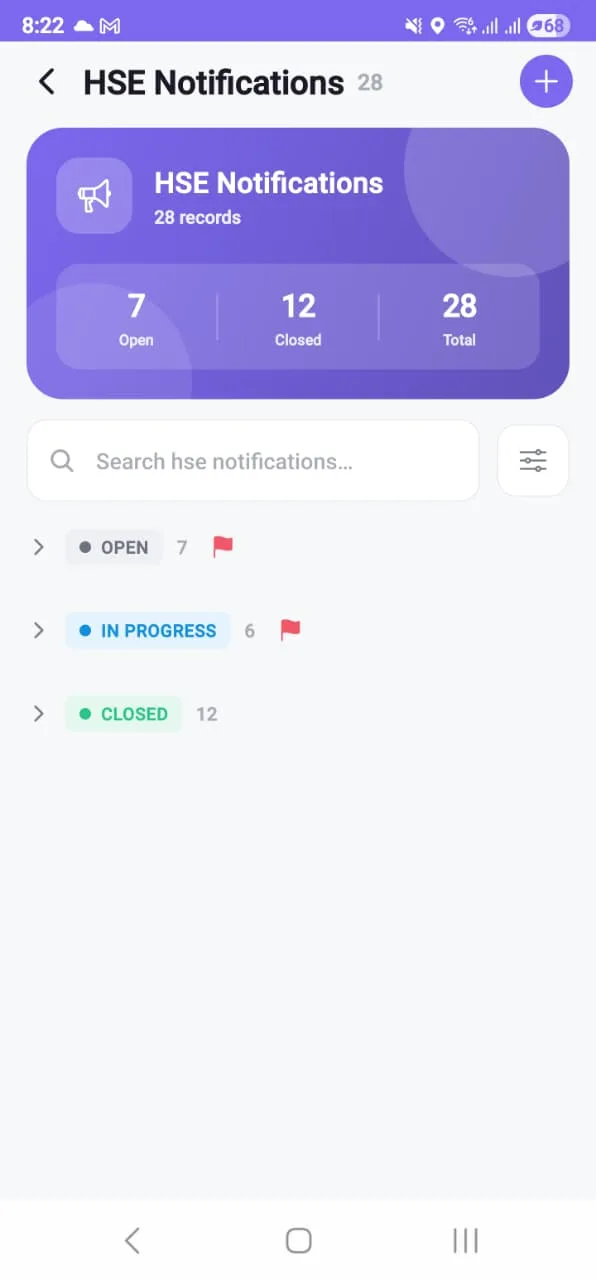
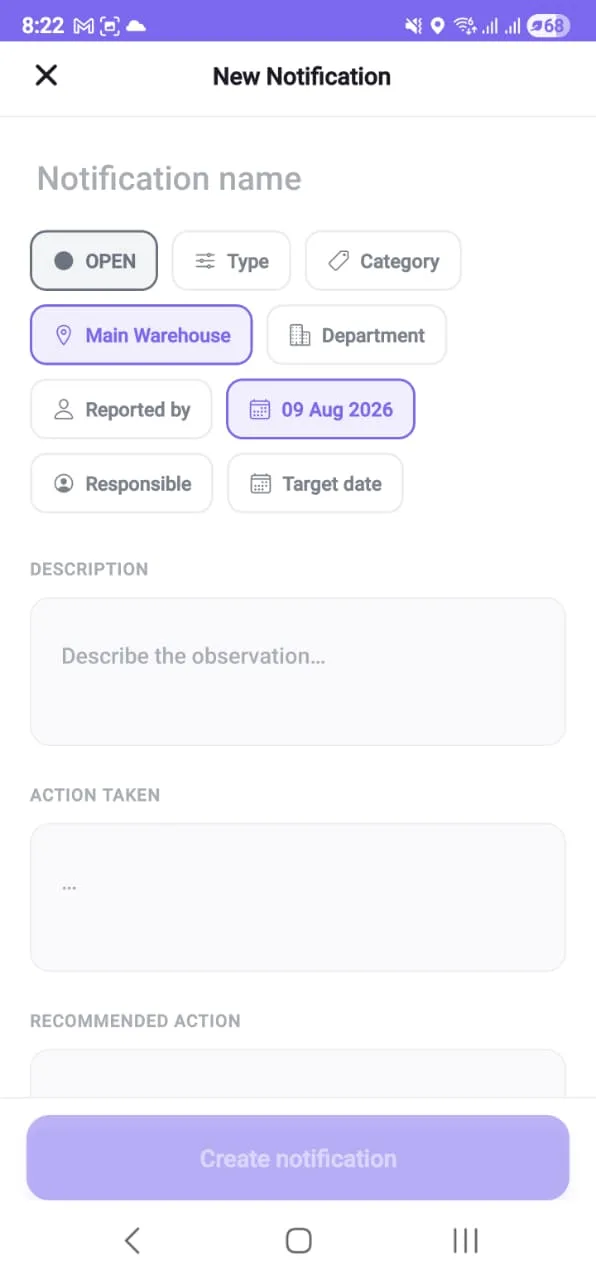
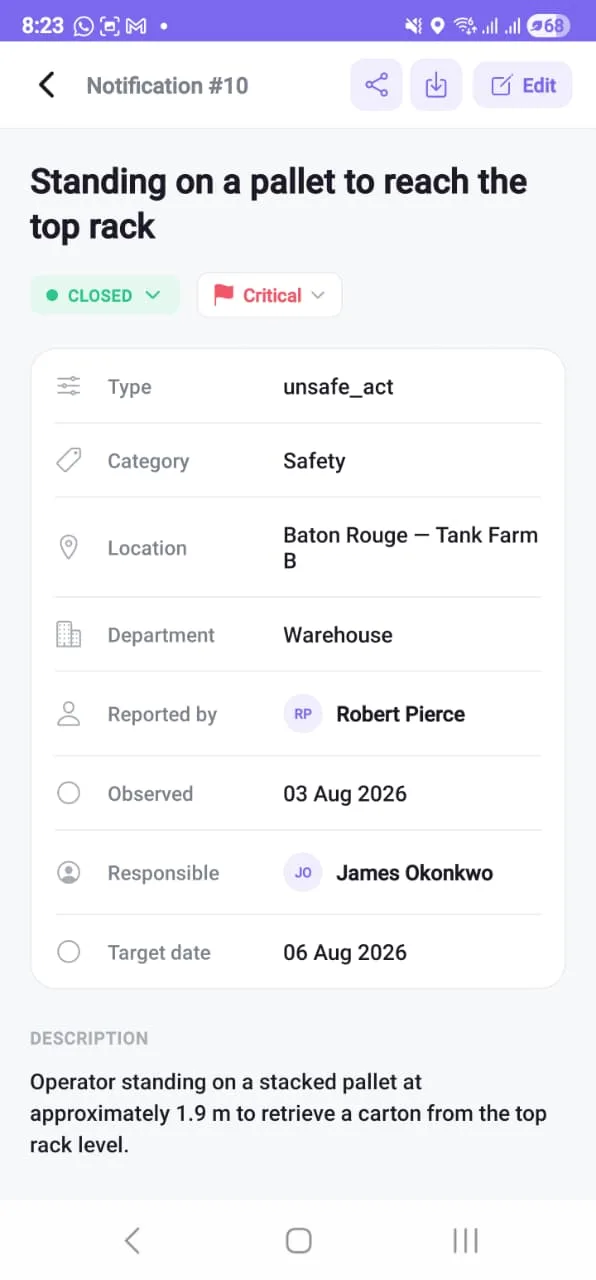
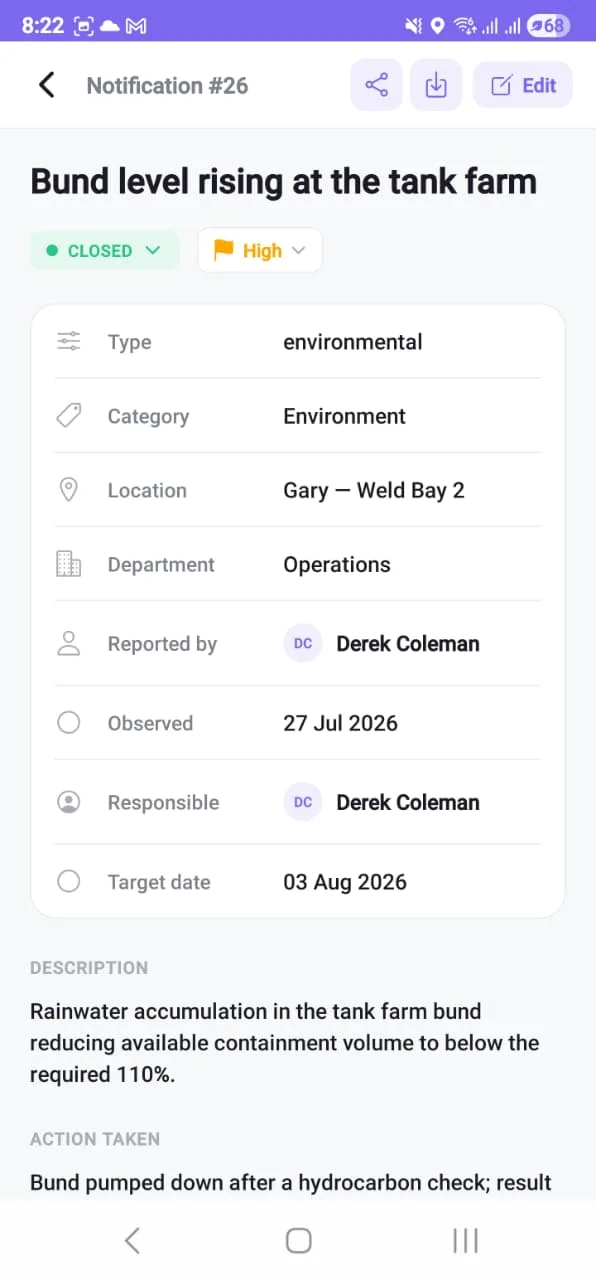
Screenshots from a working build. Illustrative records — not a customer.
Six types and three categories — Safety, Health, Environment — both managed centrally rather than hardcoded per client, and both configurable without a release.
What an auditor asks, and what you hand them
Clause by clause, the record this module produces — not a claim that it makes you compliant.
| Clause | What it asks for | What the channel hands over |
|---|---|---|
| 5.4 | Consultation & participation of workers | Anybody on site can file one, from a phone, about a place or a person |
| 6.1.2 | Hazard identification & risk assessment | Observations feed the hazard register rather than dying in a folder |
| 7.4 | Communication | The owner notified on assignment, on reassignment, and again when the target date passes |
| 7.5 | Documented information | Every observation retained, attributed field by field, and exportable |
| 8.1.2 | Hierarchy of controls | The recommendation recorded against the observation and ranked against the hierarchy |
| 9.1 | Monitoring, measurement & analysis | Reporting rate, act/condition ratio and positive share, carried as leading indicators |
| 10.2 | Incident, nonconformity & corrective action | Observation to corrective action to closure, on one chain |
| ISO 14001:2015 6.1.2 / 8.1 | Environmental aspects and operational control | Environmental observations sit in the same channel under the Environment category, not in a separate book |
| OSH Act §5(a)(1) | The general duty clause — recognised hazards | Documented identification of a recognised hazard by a worker, and the date its correction was accepted |
5.4
Consultation & participation of workers
What the channel hands over
Anybody on site can file one, from a phone, about a place or a person
6.1.2
Hazard identification & risk assessment
What the channel hands over
Observations feed the hazard register rather than dying in a folder
7.4
Communication
What the channel hands over
The owner notified on assignment, on reassignment, and again when the target date passes
7.5
Documented information
What the channel hands over
Every observation retained, attributed field by field, and exportable
8.1.2
Hierarchy of controls
What the channel hands over
The recommendation recorded against the observation and ranked against the hierarchy
9.1
Monitoring, measurement & analysis
What the channel hands over
Reporting rate, act/condition ratio and positive share, carried as leading indicators
10.2
Incident, nonconformity & corrective action
What the channel hands over
Observation to corrective action to closure, on one chain
ISO 14001:2015 6.1.2 / 8.1
Environmental aspects and operational control
What the channel hands over
Environmental observations sit in the same channel under the Environment category, not in a separate book
OSH Act §5(a)(1)
The general duty clause — recognised hazards
What the channel hands over
Documented identification of a recognised hazard by a worker, and the date its correction was accepted
Sentinel supports evidencing these requirements. Certification is an audit of your organisation, not of software — no product can be bought to pass one.
The seven things you are already thinking
They will not report anything at all unless the channel is visibly used for good practice too. That is the whole reason Positive is a first-class type rather than a checkbox: in the month below, 6 of 28 records are somebody doing the right thing, and those 6 are why the 6 unsafe acts got filed. Take the positives away and within a quarter you have a register of broken extension leads and nothing about people.
No, and deliberately. An unowned observation cannot be followed up, cannot be assigned and cannot be closed with anybody accountable for the closing. What is configurable is who can see the reporter — the record is attributed underneath either way, in the audit trail, on site time.
Your numbers will go up, which is the point. A rising observation count against a flat incident count is the trend worth putting in front of a board, and it says people are looking. A falling count is the one to worry about, and it is the reading almost every safety dashboard gets backwards.
A target date, a named owner and escalation that stops when the work is actually accepted. 6 of the 28 here are past their date, and the board counts them rather than leaving them to be discovered in an escalation email. A record that has been closed or signed off is never chased again — chasing accepted work is how a reminder engine trains people to ignore it.
Then answer this without leaving your desk: how many are past their target date right now, and who owns each one? Cards work perfectly well as a way of writing something down. They cannot be asked a question, they cannot chase anybody, and they cannot tell you whether the ratio of acts to conditions has moved in six months.
No. It records what was seen, puts a name and a date on it, and chases the date. The hierarchy of controls runs elimination, substitution, engineering, administrative, then PPE, and every one of those is something people do to a workplace. Re-marking a walkway is a control; recording that somebody re-marked it is not.
Yes, including on your own infrastructure. Permissions are granular — view, create, update and delete — and every field change is attributed in the audit trail.
See it on your own data.
Send us last quarter’s observation cards — photographs of the paper ones are fine. We will load them, split the acts from the conditions, and show you your reporting rate and how much of it is past its date.
Forty-five minutes, your scenarios, no slides.