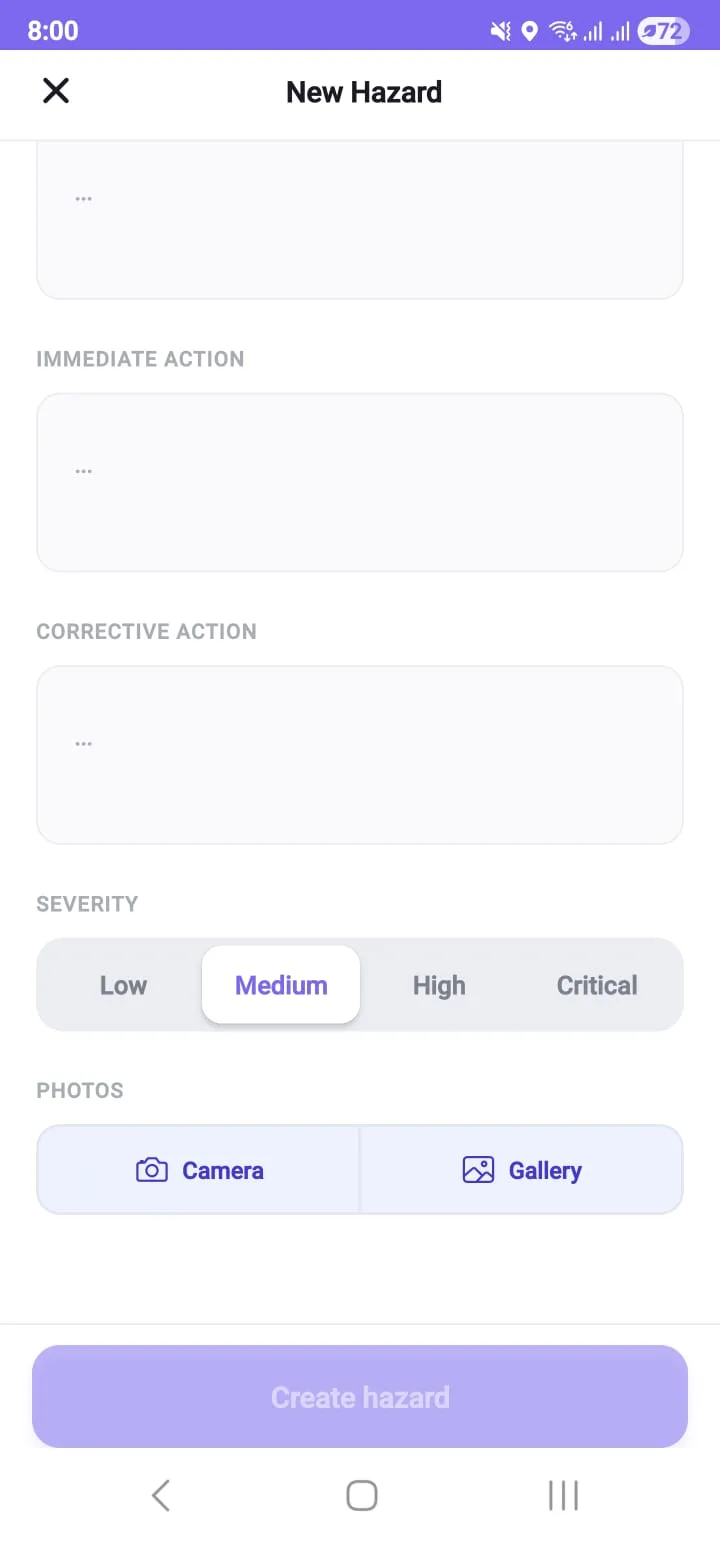
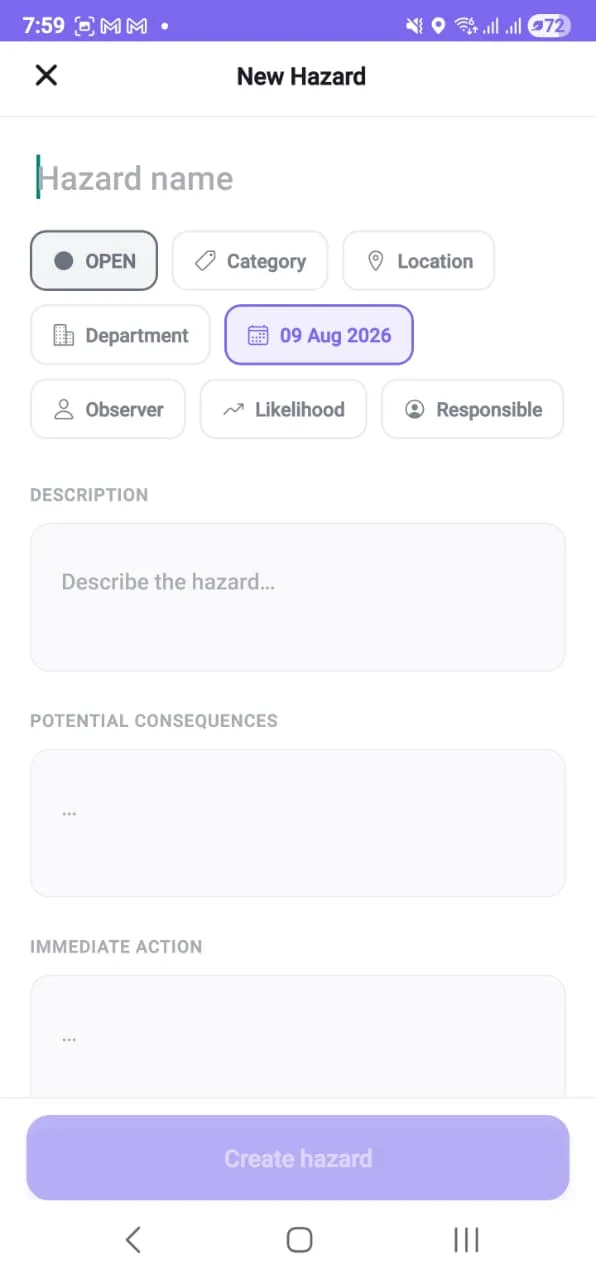
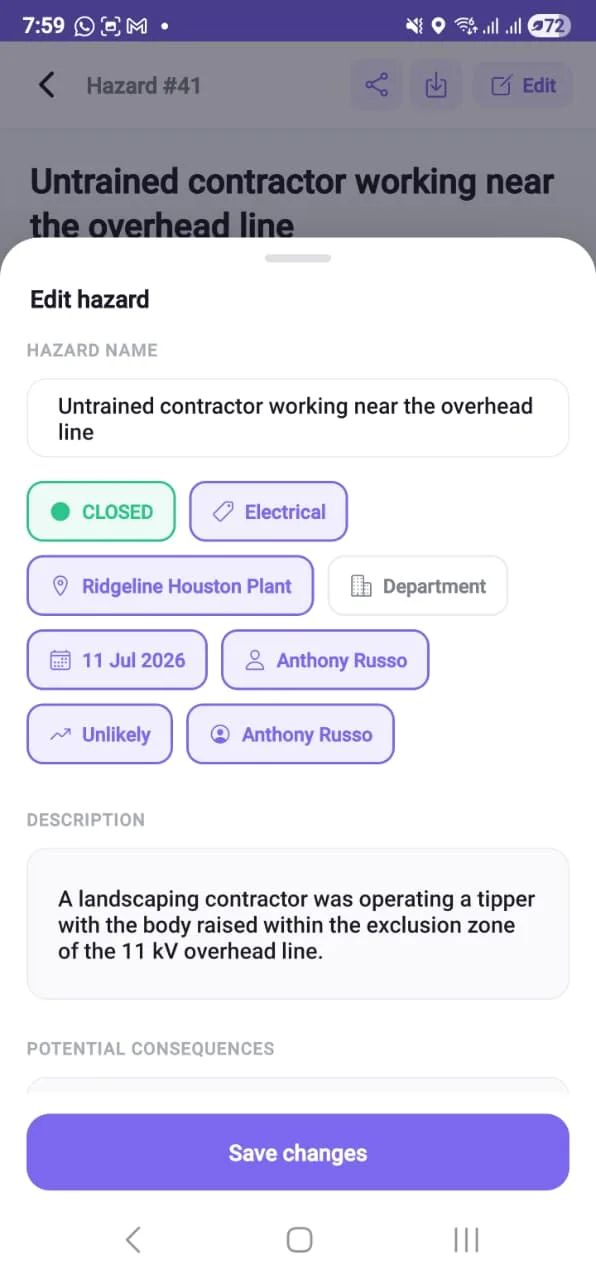
Every incident was a hazard somebody could have written down.
Report it from the floor in under a minute, rate it severity × likelihood, and let the register put the four that matter above the 38 that do not.
The only record that exists before somebody is hurt.
Everything else in an HSE system is an account of what already happened. An incident, an investigation, a clinic record — each one is the system reporting on its own failure to act on a hazard that was standing there first.
A hazard report is the one entry that can still change the outcome. It is also the easiest one not to file, because nothing has gone wrong yet and the form is back at the desk. So it does not get filed. And eleven months later the investigation finds that three people knew.
The register is not a list of problems. It is the list of things you still have a choice about.
Sorting by severity gives you the wrong list
Risk is severity × likelihood, captured as two separate judgements. Collapse them into one and the register hands the manager a list ordered by how bad it could be, rather than by what is going to happen.
Emergency generator not load-tested this year
Real, scheduled, and genuinely serious if it fails on the day it is needed. It is also not today’s problem, and treating it like one costs you the attention the row below deserves.
Offcuts accumulating at the saw station
Nobody would call this serious. Somebody will trip on it this week, and the week after that, until a person lands on a saw table instead of a floor.
A register sorted by severity puts the generator first. A register sorted by risk puts the saw station first — and the saw station is the one that will actually hurt somebody.
Severity × likelihood
Scored 1–20, banded on the way in
| Severity | Rare | Unlikely | Possible | Likely | Almost certain |
|---|---|---|---|---|---|
| Critical | 4A | 8 | 12 | 16 | 20 |
| High | 3 | 6 | 9 | 12 | 15 |
| Medium | 2 | 4 | 6 | 8 | 10B |
| Low | 1 | 2 | 3 | 4 | 5 |
- Low1–5
- Medium6–9
- High10–14
- Extreme15–20
- BOffcuts accumulating at the saw station
- Medium severity × almost certain = 10, High risk
- AEmergency generator not load-tested this year
- Critical severity × rare = 4, Low risk
Five of the hazards in the extract below carry Critical severity and none of them reach the Extreme band, because likelihood is doing the work. That is not the matrix being lenient. It is the matrix being the only thing in the building that will say so out loud.
42 hazards, four of them Extreme
A live register from a working month, ranked by risk so the Extremes are on page one without anybody sorting. Filter it by band, status, area, category and owner — or search the text of the controls, not just the titles.
Hazard register
One working month, ranked by risk rather than severity
| Risk | Hazard | Area | Severity | Likelihood | Owner | Status |
|---|---|---|---|---|---|---|
| Extreme· 16 | Guard interlock bypassed on the bandsaw | Gary — Weld Bay 2 | Critical | Likely | Anthony Russo | Open |
| Extreme· 16 | Exposed conductor at the weld bay junction box | Gary — Weld Bay 2 | Critical | Likely | Anthony Russo | In review |
| Extreme· 15 | Unlabelled decanted solvent, maintenance bench | Houston — Maintenance Shop | High | Almost certain | James Okonkwo | Closed |
| Extreme· 15 | Fire door wedged open, store to plant | Ridgeline Houston Plant | High | Almost certain | Anthony Russo | In review |
| High· 12 | Missing edge protection, mezzanine loading gate | Houston — Warehouse A | Critical | Possible | Anthony Russo | Open |
| High· 12 | Reversing area with no pedestrian separation | Houston — Loading Dock 3 | Critical | Possible | Marcus Delgado | Open |
| High· 12 | Reversing alarm inaudible at the yard gate | Phoenix — Dock Apron | High | Likely | Marcus Delgado | In review |
| High· 10 | Offcuts accumulating at the saw station | Gary — Weld Bay 2 | Medium | Almost certain | Tanya Brooks | Open |
| High· 10 | Manual handling at the drum decanting bench | Houston — Chemical Yard | Medium | Almost certain | Tanya Brooks | Open |
| High· 10 | Noise at the press line above the action level | Ridgeline Houston Plant | Medium | Almost certain | Priya Natarajan | In review |
| Medium· 8 | Sprinkler isolation valve found unlocked | Ridgeline Houston Plant | Critical | Unlikely | Anthony Russo | Closed |
| Medium· 8 | Untrained contractor working near the overhead line | Ridgeline Houston Plant | Critical | Unlikely | Anthony Russo | Closed |
| Medium· 6 | Forklift horn intermittent on truck FL-04 | Houston — Warehouse A | Medium | Possible | James Okonkwo | Open |
| Low· 5 | Cardboard build-up at the recycling point | Houston — Warehouse A | Low | Almost certain | Robert Pierce | In review |
| Low· 4 | Emergency generator not load-tested this year | Ridgeline Corporate Office | Critical | Rare | James Okonkwo | In review |
| Low· 2 | Chair with a seized gas lift, meeting room | Ridgeline Corporate Office | Low | Unlikely | Karen Liu | Closed |
- Extreme· 16CriticalOpen
Guard interlock bypassed on the bandsaw
- Area
- Gary — Weld Bay 2
- Likelihood
- Likely
- Owner
- Anthony Russo
- Extreme· 16CriticalIn review
Exposed conductor at the weld bay junction box
- Area
- Gary — Weld Bay 2
- Likelihood
- Likely
- Owner
- Anthony Russo
- Extreme· 15HighClosed
Unlabelled decanted solvent, maintenance bench
- Area
- Houston — Maintenance Shop
- Likelihood
- Almost certain
- Owner
- James Okonkwo
- Extreme· 15HighIn review
Fire door wedged open, store to plant
- Area
- Ridgeline Houston Plant
- Likelihood
- Almost certain
- Owner
- Anthony Russo
- High· 12CriticalOpen
Missing edge protection, mezzanine loading gate
- Area
- Houston — Warehouse A
- Likelihood
- Possible
- Owner
- Anthony Russo
- High· 12CriticalOpen
Reversing area with no pedestrian separation
- Area
- Houston — Loading Dock 3
- Likelihood
- Possible
- Owner
- Marcus Delgado
- High· 12HighIn review
Reversing alarm inaudible at the yard gate
- Area
- Phoenix — Dock Apron
- Likelihood
- Likely
- Owner
- Marcus Delgado
- High· 10MediumOpen
Offcuts accumulating at the saw station
- Area
- Gary — Weld Bay 2
- Likelihood
- Almost certain
- Owner
- Tanya Brooks
- High· 10MediumOpen
Manual handling at the drum decanting bench
- Area
- Houston — Chemical Yard
- Likelihood
- Almost certain
- Owner
- Tanya Brooks
- High· 10MediumIn review
Noise at the press line above the action level
- Area
- Ridgeline Houston Plant
- Likelihood
- Almost certain
- Owner
- Priya Natarajan
- Medium· 8CriticalClosed
Sprinkler isolation valve found unlocked
- Area
- Ridgeline Houston Plant
- Likelihood
- Unlikely
- Owner
- Anthony Russo
- Medium· 8CriticalClosed
Untrained contractor working near the overhead line
- Area
- Ridgeline Houston Plant
- Likelihood
- Unlikely
- Owner
- Anthony Russo
- Medium· 6MediumOpen
Forklift horn intermittent on truck FL-04
- Area
- Houston — Warehouse A
- Likelihood
- Possible
- Owner
- James Okonkwo
- Low· 5LowIn review
Cardboard build-up at the recycling point
- Area
- Houston — Warehouse A
- Likelihood
- Almost certain
- Owner
- Robert Pierce
- Low· 4CriticalIn review
Emergency generator not load-tested this year
- Area
- Ridgeline Corporate Office
- Likelihood
- Rare
- Owner
- James Okonkwo
- Low· 2LowClosed
Chair with a seized gas lift, meeting room
- Area
- Ridgeline Corporate Office
- Likelihood
- Unlikely
- Owner
- Karen Liu
Showing 16 of 16 rows — sixteen of 42 hazards in the period. Read the last three rows: two carry Critical severity and both rank below a housekeeping issue graded Low, because likelihood is doing the work.
13
14
13
2
Four states, not three. Closing a hazard is a claim somebody makes; Approved is the signature on it, and only the sign-off workflow can set it — including for an administrator, who cannot sign on somebody else’s behalf.
If everything on it is serious, people have stopped reporting the rest.
A register of nothing but Highs and Extremes is not a well-run site. It is a site where only the undeniable gets written down — where somebody decided, correctly, that a torn mat is not worth the trouble of the form.
Torn matting, a cable across a corridor, cardboard past the line. Individually trivial; collectively the proof that reporting is normal behaviour rather than an escalation. Watch the Low count. When it goes to zero, the channel has closed — and the next thing you hear about will not be a hazard.
The three Low-band rows in this month
- Low· 5Cardboard build-up at the recycling pointHouston — Warehouse A
- Low· 4Emergency generator not load-tested this yearRidgeline Corporate Office
- Low· 2Chair with a seized gas lift, meeting roomRidgeline Corporate Office
A seized gas lift on a meeting-room chair is on the register of an operator that also has an Extreme open on a bandsaw. Nobody confused the two. The point is that both got written down by somebody who expected it to be worth doing.
Two different questions, two different fields
Most systems give you one box and get the first answer. The second is the one the auditor is asking about, and the third is the one that decides how hard anybody works on the second.
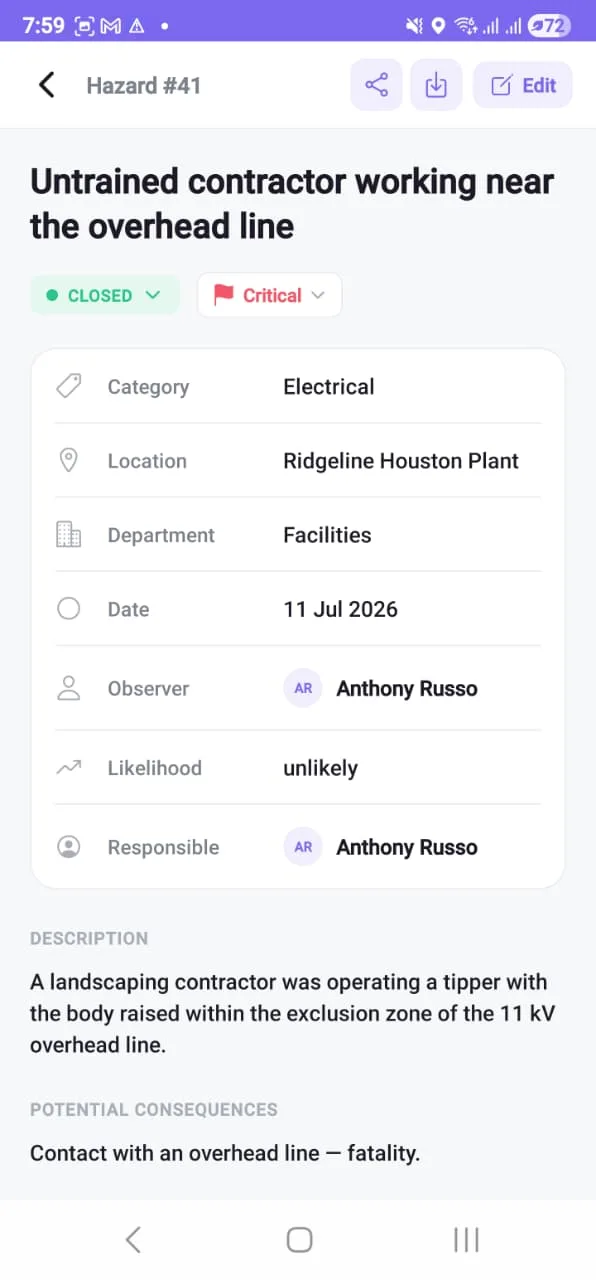
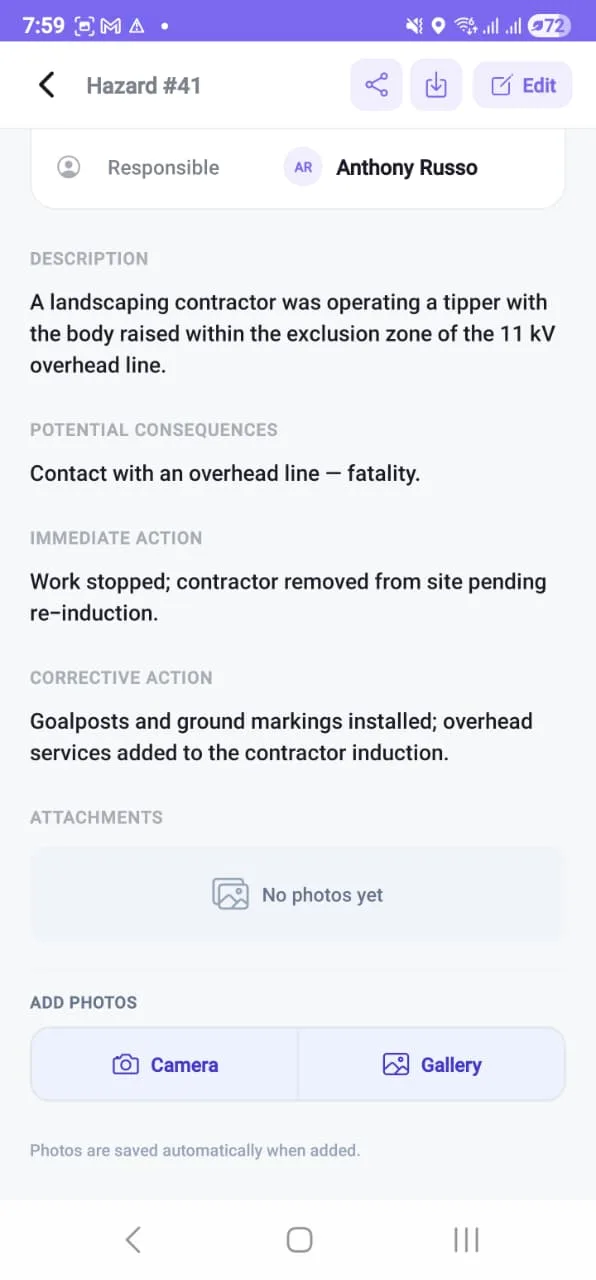
Hazard #41 · Electrical · Ridgeline Houston Plant · 11 Jul 2026
Description
A landscaping contractor was operating a tipper with the body raised within the exclusion zone of the 11 kV overhead line.
What is actually there, written where it is standing.
Potential consequences
Contact with an overhead line — fatality.
What this would have caused. The field that decides how hard anybody works on the last one.
Immediate action
Work stopped; contractor removed from site pending re-induction.
What was done on the spot. Necessary, and not the same as a control.
Corrective action
Goalposts and ground markings installed; overhead services added to the contractor induction.
What stops it recurring. This one becomes a dated, owned row on the CAPA board.
The corrective action does not live on the hazard
It becomes a row on the same tracker that incidents, inspections, near misses and failed equipment checks feed — with an owner, a date and automatic chasing. Hazard #38, the open Extreme at the top of the register, reads like this:
- Potential consequences
- Contact with the blade — amputation.
- Immediate action
- Machine locked out and the cable tie removed.
- Corrective action
- Interlock replaced with a tamper-resistant type; management-of-change raised on all guard modifications.
Only the third one is a control, and it is a control because somebody fitted a different interlock — not because it was typed into a box. It is on the corrective-actions board with its hazard as its source, which is where it gets chased from.
The hierarchy of controls runs elimination, substitution, engineering, administrative, then PPE — and every one of those is something people do to a workplace. This platform records which one was chosen and evidences that it happened. It is not itself a control, and any vendor telling you otherwise is selling you a filing cabinet as a machine guard.
Rename the levels and the matrix follows
Severity is configured in Settings — key, label, colour and order. Every surface reads that configuration rather than a constant compiled into the product.

The demo runs 4 severity levels and 5 likelihood levels, which is where the 20-point scale comes from. A site that runs five severity levels, or calls the top one Catastrophic, or reports in Spanish, does not get a different product — it gets its own vocabulary.
- The matrix redraws to the new dimensions, and the band edges move with it.
- The register colours, the phone pickers and the filter options all follow.
- The per-hazard PDF draws the configured matrix and marks that hazard’s cell.
- Exports carry your labels, so a spreadsheet handed to an auditor reads in your language.
One thing does not move: the score is computed the same way on the phone, on the server and on the dashboard. Two people rating the same hazard cannot land in different cells.
Seen, to evidenced
Eight steps. The platform has no part in the first one, which is the only reason the other seven are worth anything.
- 01
Seen
On the floor, by somebody who was not looking for it. This is the only step the platform has no part in, and it is the one the whole register depends on.
- 02
Reported
From a phone, in front of the thing, in under a minute. A photo attaches at the point of reporting rather than being emailed in later.
- 03
Rated
Severity and likelihood picked as two separate judgements. The score and the band are computed — identically on the phone, the server and the dashboard.
- 04
Assigned
A named responsible person, notified that it has landed on them. Reassign it and the new owner is notified too.
- 05
Made safe
The immediate action is recorded as its own field. What was done on the spot is a different question from what stops it recurring.
- 06
Controlled
The corrective action becomes an owned, dated item in the same tracker every other module feeds, chased automatically when it runs late.
- 07
Reviewed
Open to In review to Closed, and Approved where a closure needs authorising. Closing is a claim; the sign-off is the check on it.
- 08
Evidenced
Every field change attributed on site time, a per-hazard PDF with the matrix drawn and its cell marked, and the filtered register exportable.


Screenshots from a working build. Illustrative records — not a customer.
What an auditor asks, and what you hand them
Clause by clause, the record this module produces — not a claim that it makes you compliant.
| Clause | What it asks for | What the register hands over |
|---|---|---|
| 6.1.2 | Hazard identification & risk assessment | The register itself, and a risk rating on every row of it |
| 8.1.2 | Hierarchy of controls | Immediate and corrective actions recorded against the hazard, ranked against the hierarchy |
| 8.1.3 | Management of change | A guard modification raises management-of-change rather than closing quietly |
| 5.4 | Consultation & participation of workers | Anybody on site can file one from a phone, in front of the thing |
| 7.4 | Communication | The responsible person notified on assignment, and again on reassignment |
| 7.5 | Documented information | Every hazard retained, attributed field by field, and exportable |
| 9.1 | Monitoring, measurement & analysis | Hazard reporting rate carried as a leading indicator, not a lagging one |
| 10.2 | Incident, nonconformity & corrective action | Hazard to corrective action to closure, on one chain |
| OSH Act §5(a)(1) | The general duty clause — recognised hazards | Documented identification of a recognised hazard, the control chosen against it, and the date it was verified |
6.1.2
Hazard identification & risk assessment
What the register hands over
The register itself, and a risk rating on every row of it
8.1.2
Hierarchy of controls
What the register hands over
Immediate and corrective actions recorded against the hazard, ranked against the hierarchy
8.1.3
Management of change
What the register hands over
A guard modification raises management-of-change rather than closing quietly
5.4
Consultation & participation of workers
What the register hands over
Anybody on site can file one from a phone, in front of the thing
7.4
Communication
What the register hands over
The responsible person notified on assignment, and again on reassignment
7.5
Documented information
What the register hands over
Every hazard retained, attributed field by field, and exportable
9.1
Monitoring, measurement & analysis
What the register hands over
Hazard reporting rate carried as a leading indicator, not a lagging one
10.2
Incident, nonconformity & corrective action
What the register hands over
Hazard to corrective action to closure, on one chain
OSH Act §5(a)(1)
The general duty clause — recognised hazards
What the register hands over
Documented identification of a recognised hazard, the control chosen against it, and the date it was verified
Sentinel supports evidencing these requirements. Certification is an audit of your organisation, not of software — no product can be bought to pass one.
The seven things you are already thinking
Then answer this without leaving your desk: how many Extremes are open right now, and who owns each one? The book is a fine place to write a hazard down. It is a bad place to ask a question of, and it cannot chase anybody. In the illustrative month on this page 4 of 42 hazards are Extreme, and the register puts all 4 on the first screen without anybody sorting them.
They do not fill one in. They pick one word from a list of 4 and one from a list of 5, in front of the thing they are looking at. The multiplication, the score out of 20 and the band are computed — the same way on the phone, the server and the dashboard, so two people rating the same hazard cannot land in different cells.
The person standing in front of it, and their first judgement is revisable at review. That trade is deliberate: an estimate written at the point of reporting is worth more than a better estimate that never gets written because it needed a meeting. The point is that it is recorded and attributable, not that it is right first time.
Then configure the scale — key, label, colour and order, in Settings. Every surface reads that configuration: the matrix, the register colours, the phone pickers, the exports and the PDF. Sites that report in a second language or run a different number of levels do not get a different product, they get their own vocabulary.
That is the finding, and it is the earliest warning this platform gives you. A register with no Low-band rows is not a well-run site — it is a site where only the undeniable gets written down. In the month on this page 3 hazards are Low band, including a chair with a seized gas lift. When that number goes to zero, the channel has closed and the next thing you hear about will be an incident.
No. It ranks, it chases and it records; it does not control anything. The hierarchy of controls runs elimination, substitution, engineering, administrative, then PPE, and every one of those is something people do to a workplace. What the platform can do is make sure the control somebody chose has an owner, a date and evidence attached to it.
Yes, including on your own infrastructure. Permissions are granular — view, create, update and delete — and every field change is attributed in the audit trail on site time.
See it on your own data.
Send us last quarter’s hazard log — a spreadsheet, or photographs of the book in the guard hut. We will load it, rate it, and show you which of your hazards outrank the ones you have been working on.
Forty-five minutes, your scenarios, no slides.